
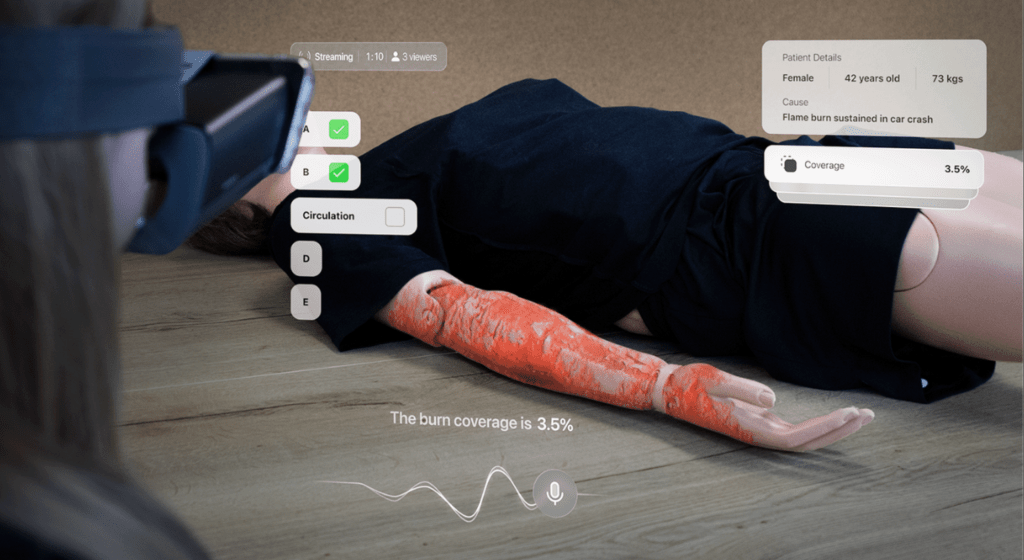
A healthcare collaborative project has led to a cutting-edge use case for mixed reality technologies, an analysis from Team Consulting has found.
Citing a use case between clients Dr Stefan Hudson, Clinical Innovation Fellow and Ryan Kerstein, Consulant Plastic Surgeon, Buckinghamshire NHS Trust, the article highlighted how mixed reality could help train surgeons, leading to reduced costs.
Using MR, medical professionals could use immersive technologies to train surgeons dealing with burn patients. Simulation technologies could allow the NHS to tackle the complex nature of burn surgeries, without using physical materials and by replicating the exercises to improve training outcomes, learner retention, and much more.
The findings explained that trainee surgeons had to use mannequins costing roughly £120k and with limited physical features. Such limitations could lower surgeon confidence, diminishing performance in real-world scenarios.
Team Consulting later revealed that it had used mixed reality headsets to map “custom digital burns” onto trainee mannequins to illustrate a broader range of burn scenarios. Doing so led to better, more precise assessment outcomes for medical professionals.
Not only did this improve assessments, but teams could also livestream their training directly to the headset, significantly increasing the quality of feedback provided to the NHS and others.
Prior to conducting the tech stack integration, software engineering teams developed a demonstrator “in two days” using a mixture of software packages, phone apps, and bespoke code.
Collaborating with their client, Team Consulting later focused on potential improvements to the training simulation with help from research at the Stoke Mandeville Hospital in Aylesbury.
Initially, the project ‘tailored’ each burn to specific conditions and contexts, allowing surgeons to assess and record simulated burn injuries. Later, they developed metrics for the simulation, including the size, depth, cause, and placement of the burn, which, in its completed stage, could superimpose over trainee mannequins for assessment.
Software engineers also took extra care to preserve hand occlusion to merge the virtual and physical content during training activities with optimal realism.
PTC Vuforia: AR Enabled for the Enterprise
According to the Team Consulting article, the solution has tapped Vuforia for its augmented reality (AR) capabilities.
Developed by Boston, Massachussets-based tech company PTC, Vuforia allows companies to digitally transform with immersive AR.
Primarily used for frontline workers, Vuforia operates its Model Targets and Area Targets computer vision technologies across the cloud, on-site, and via software-as-a-service (SaaS) solutions.
With it, the firm has the capacity to overlay digital content on the physical world, at the enterprise level, to train, guide, and assess frontline workers.
It platform can also seamlessly integrate product and asset data for use with computer aided design (CAD)-powered augmented reality solutions. This can include remote guidance, visual inspections, and step-by-step training for equipment operators.
Furthermore, Vuforia’s solution portfolio includes Vuforia Studio, Chalk, and Expert Capture, which are instrumental in assisting workflows.
Supported devices include Magic Leap, Microsoft HoloLens 2, and RealWear’s HMT-1, HMT-1Z1, Navigator 500, and Navigator 520. Furthermore, Vuforia taps low and no-code capabilities for accessible use across industry verticals, significantly reducing time-to-market.
Like this article? Be sure to like, share, and subscribe to our LinkedIn, Facebook, and Twitter pages for the latest updates.


 Deus×Machina
Leave a comment