
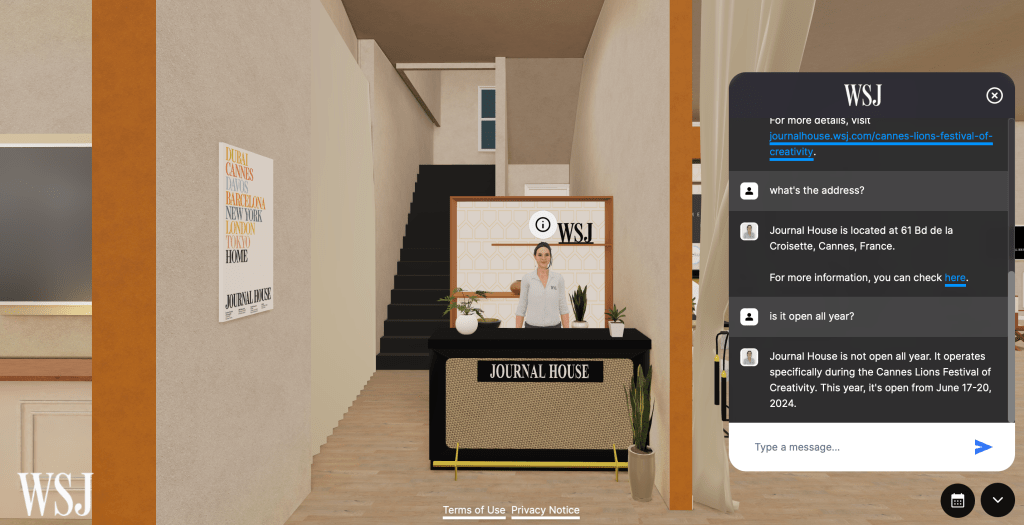
At the Cannes Lions Festival in June, the premier event invited people from across the physical and virtual worlds to explore creativity and ingenuity.
MeetKai, a trailblazing company based in Los Angeles, California, created a metaverse experience for the Wall Street Journal, allowing people from across the world to learn more about the publication’s operations.
Incorporating digital twins, virtual assistants, and artificial intelligence (AI), the cutting-edge Journal House immersive space remained interoperable as well as forward-thinking.
Users could also access interoperable platform on their mobiles, tablets, PCs, and virtual and mixed reality headsets.
At the time, Gabrielle Doyle, Executive Director of Strategy and Operations for Live Journalism and Events, WSJ, lauded the solution for its expansive involvement of partners, content, and outreach.
To explore the venture into the digital frontier, DxM has the pleasure of interviewing Peter John Alexander, Chief Business Officer, MeetKai, to discuss the recent collaboration.
DxM: Following the Cannes Lions event, can you explain the WSJ’s creative vision for its digital twin experience? How does it fit into the themes that were present at the International Festival of Creativity?
Peter John Alexander: This experience aimed to provide a seamless, interactive virtual version of Journal House Cannes Lions.
It allowed remote visitors to immerse themselves in the event’s atmosphere and activities as if they were physically present — all while AI-virtual intelligent avatars provided informative and engaging experiences, enhancing each user’s sense of presence and participation.
When it comes to innovation, creativity, and inclusivity, Cannes Lions has always celebrated cutting-edge ideas and transformative approaches in the creative industry.
WSJ’s digital twin embodied these principles by leveraging advanced technology to expand event participation in a cost-efficient way.
DxM: Have you upgraded any of the interoperable tools and resources on the MeetKai platform? How did they facilitate seamless interactions with online staff and your bespoke experiences?
Peter John Alexander: We continuously enhance our internal tools and leverage cutting-edge technology to deliver innovative and engaging experiences for every world we build.
We’ve focused particularly on improving user experiences and visual fidelity, and while these upgrades enhance our platform’s overall functionality, they’re not specific to different MeetKai experiences or products.
Rather, these improvements streamline collaboration with online staff and enhance custom experiences for all clients, making them more seamless and easy to use.
DxM: Can you go into more detail about MeetKai’s AI-powered avatars? What are their primary roles, and how did they contribute to the online experience?
Peter John Alexander: Our AI powered avatars are essentially embodied AIs within the experience or what we call “Immersive AI”. They will look like regular avatars or characters as you explore the world, but if you interact with them, you’ll realize they have conversational capabilities.
They can offer a natural conversation in real time, are trained to answer questions, and offer facts and insights on the event’s venue, history, programming, partners, and any other details that virtual and in-person guests can think of.
Mini-games become more interesting, sales assistants become more useful, and the experience overall feels more fulfilling.
When it comes to building immersive environments, our VIPs can contribute to more realistic encounters while adding immense value to each user’s experience.

Each journey becomes completely unique, just like different people can perceive and engage with different elements in a real shared space.
It’s also a fun, unconventional way to offer a brand’s resources and services for less than ever before.
DxM: Do you see growth potential for the Metaverse, and is the term still valid in 2024? Why so?
The term has always been valid. and using it today is just a matter of preference. It first appeared in Neal Stephenson’s 90s science fiction novel, Snow Crash, and my take is, as companies build platforms and worlds that resemble its original description, it makes perfect sense for them to use the term if they’re fond of it.
The metaverse in Snow Crash is depicted as a vast, computer-generated universe that parallels the physical world, a shared space for social interaction, commerce, and entertainment.
I do think we’ll see more of these experiences succeed over time, and it is already a multibillion dollar market for multiple reasons.
Companies across several industries, including technology, gaming, social media, and entertainment, are heavily investing in the development of all related technologies. What we do is build the platforms needed for the rapid development of these applications, using AI to reduce their cost and delivery timelines by more than 75 percent.
We ensured broader accessibility regardless of geographical constraints and, not only showcased the potential of virtual events, but also underscored WSJ’s commitment to innovation and adaptability in a fast-evolving media landscape.
Expansion of MeetKai’s Metaverse Use Cases
News of MeetKai’s latest collaboration comes after a recent partnership with the Charlotte Hornets, with the basketball team showcasing the National Basketball Association’s (NBA) first-ever metaverse shop.
At the pioneering digital space, users could explore information about the NBA team, buy physical goods from the online store, and interact with others.
James Kaplan, Co-Founder and CEO, MeetKai, Weili Dai, Co-Founder and Executive Chairwoman, MeetKai, and Seth J Bennett, Chief Marketing Officer, Charlotte Hornets explained how their joint effort led to the development of the NBA’s first-ever foray into the Metaverse, its impact on visitors, and the future of connecting with the sport’s fans
For more information, kindly visit MeetKai’s website.
Like this article? Be sure to like, share, and subscribe for all the latest updates from DxM!



 Deus×Machina
Leave a comment