
Microsoft has reportedly inked a deal with South Korean tech giant Samsung for the latter to provide novel micro-OLED displays for the former’s future mixed reality headset, an article from The Elec has found.
As found by Windows Central and Road to VR, the Elec stated that “industry sources” at the time revealed that Samsung Display had struck the deal with Microsoft to “develop and supply […] hundreds of thousands” of micro-OLED displays for the upcoming devices.
The insider continued as quoted in the report,
“I understand that [Microsoft] is making new devices for enjoying or watching content such as games or movies rather than the metaverse.”
The source added,
“Even if they set the specifications for the [OLEDoS] and develop and mass-produce it, it will likely be the year after next at the earliest that [Microsoft] will introduce a device equipped with it.”
Some ‘Windows’ Close, Others Open to Mixed Reality
The news comes after several mixed reality projects were shuttered by the Redmond, Washington-based company.
For example, it revealed in December last year that it had shut down its Windows Mixed Reality platform and the previous year, placed its plans to build a HoloLens 3 headset on indefinite hold.
Further issues erupted after Microsoft laid to rest AltspaceVR, a popular avatar-based virtual reality (VR) social platform.
Microsoft then resurrected it under Microsoft Mesh, with new features and integrations, across Meta Quest headsets and Microsoft Teams.
However, Mesh no longer supports the HoloLens 2 as an official device.
Samsung ‘Displays’ OLEDoS Breakthrough at Event
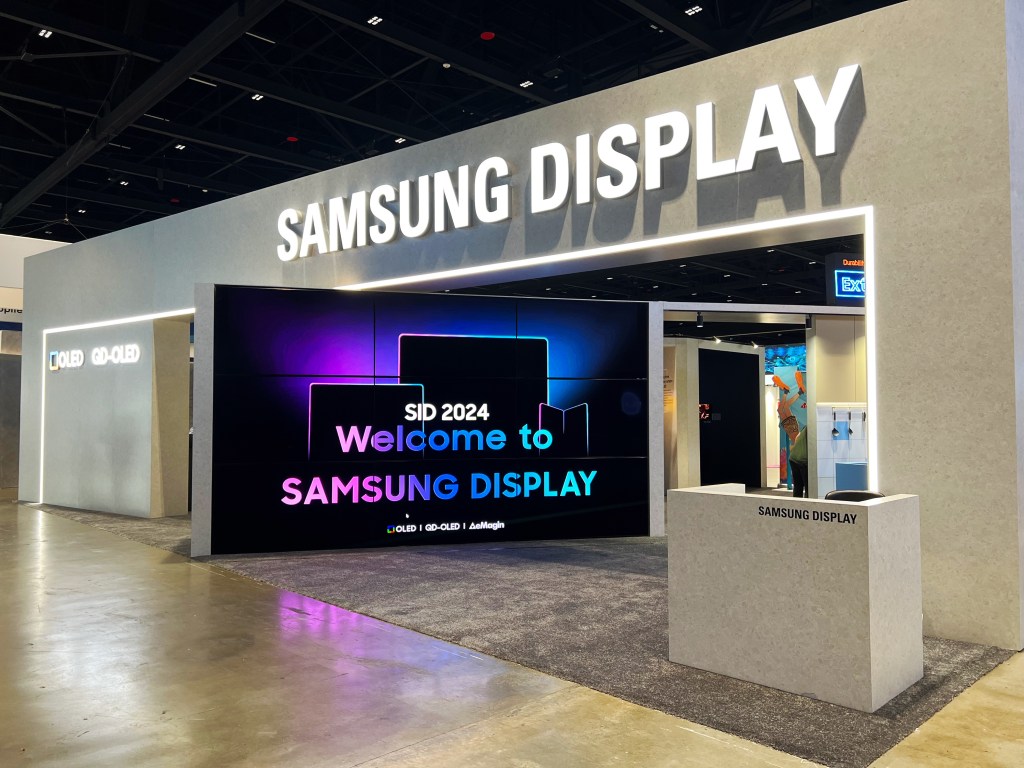
The news comes after Samsung Display showcased several fresh innovations at the SID Display Week 2024 in San Jose, California, USA.
The event took place 14-16 May and featured several of the company’s “next-generation quantum dot (QD) technology, glasses-free 3D displays, and fine silicon masks (FSMs) for RGB OLED deposition,” it said in a press release.

One of the key components for extended reality (XR) were Samsung Display’s RGB OLEDoS displays from subsidiary display firm eMagin. According to specifications, the displays leverage 3,500 PPI fine silicon mask (FSM) technologies capable of “ultra-high resolution displays.”
It noted,
This is considered to be a key technology for future RGB OLED manufacturing, as it enables denser pixel realization than conventional fine metal masks (FMMs) by creating microscopic holes through a semiconductor lithography process.”
With the new technologies, many in the XR market are expected to secure their supply chains with companies like Samsung capable of scaling component production to customer and client demands, it is understood.
Like this article? Be sure to like, share, and subscribe for all the latest updates from DxM!




 Deus×Machina
Leave a comment