
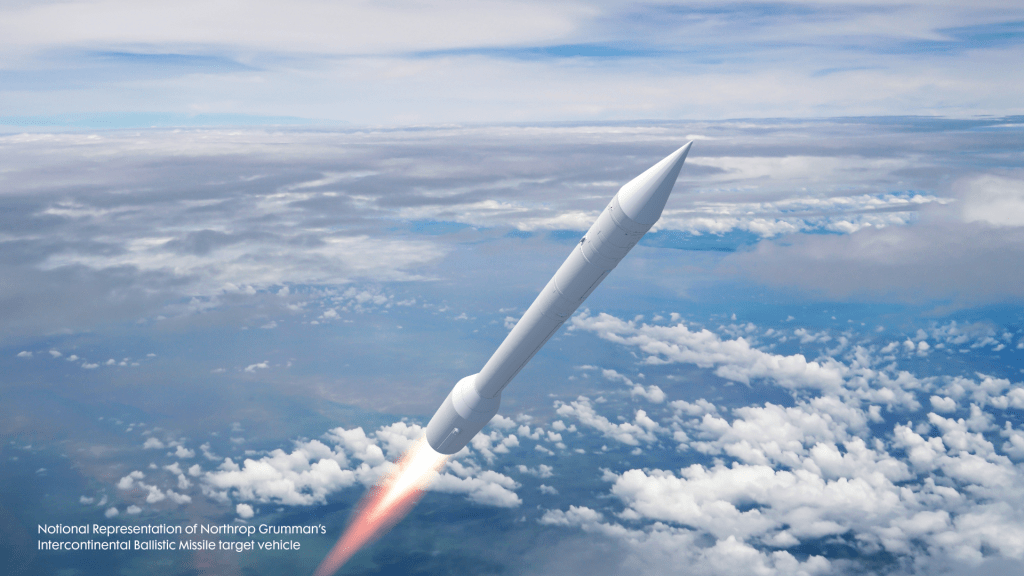
Northrop Grumman, one of the biggest defence firms in the United States, has begun leveraging virtual and augmented reality (VR/ AR) technologies to simulate its weapons efficacy.
Announced last week, the Falls Church, Virginia-based aerospace and defence giant has begun using VR and AR tools to transform its intercontinental ballistic missile (ICBM) target vehicle capacity.
It added that the new ICBM simulation will work with “advanced front ends to simulate sophisticated, long-range ballistic missile threats.”
Also, the new virtual trials will reduce risk, boost end-to-end testing, and improve on operational and manufacturing processes.
The United States Missile Defense Agency (MDA) uses the target vehicle for their ICBM operations. With ICBM target vehicle technologies, the US MDA can continue to improve on its national readiness against targets demonstrated in its Midcourse and Aegis Ballistic Missile Defense Systems.
In the new design, the company has swapped its Trident C4 first-stage solid rocket motor with an upgraded Peacekeeper SR119, allowing it to extend its strike range, lift, and payload capabilities.
However, with the new VR and AR kit, Northrop Grumman can animate and validate the vehicle’s configurations, integration, stacking, and field operations, commonly known as pathfinding, the firm noted.
Changing Up the Programme
The news comes after the US company upgraded its target vehicle from the RS119 to the Trident C4, leading to the performance improvements and further empowering US defence forces in testing and mission optimisation. After a Critical Design Review, the defence company aims to launch initial flight tests “in late 2025,” it said in a statement.
Robert Heard, Director of Targets, Northrop Grumman said that his company’s approach to building target vehicles had enabled it to “pair new and proven technologies together” to build top solutions for customers.
He concluded: “It’s about finding the right balance of affordability and innovation – combining capable, government-owned surplus motors and sophisticated front ends to simulate current and emerging threats.”
D×M understands that the MDA could utilise such target vehicles in its military exercises, similar to the Pacific Dragon 2024 (PD24) near Kauai and the Pacific Missile Range Facility in Hawaii.
The large-scale exercise takes place every two years to test the US military’s integrated air and missile defence (IAMD) capabilities.
Working with military coalition divisions from Italy, the United Kingdom, Australia, Japan, Denmark, South Korea, and Netherlands, the massive fire exercises work to improve joint coordination and interoperability.
Defence Readiness and Spatial Computing
According to a 2021 Wipro report, militaries have traditionally employed extended reality (XR) technologies for operational readiness, situational awareness, indoor and outdoor navigation, and military training.
However, with the advent of spatial simulation technologies, companies are now simulating weapons and aerospace prototype performance to innovate their products prior to production, allowing cost-conscious defence programmes to save money in their annual budgetary spending.
For example, D×M learned in an interview that Siemens had partnered with aerospace and defence firm Aeralis to simulate wind tunnel performance for its prototyped aerospace designs.
Leveraging Siemens’ NX design platform, Aeralis could load computer-aided design (CAD) data into the former’s Simcenter STAR-CCM+ computational fluid dynamics software platform to build the simulated environment, and then use VR headsets to immerse in the experiment.
READ MORE: Thoughts on NATO’s DIANA, Emerging Technologies, and Next-Gen Warfare
Designers could use controllers to set parameters in the simulation like digital smokestacks, model scaling, and airflow trajectories.
These took place at the early developmental stage, saving Aeralis critical capital in their production workflows and, in the future, post-production manufacturing.
Another company, LuminousXR, has also stepped up its efforts to provide learning and development (L&D) tools for military forces.
Whilst also working in the educational, energy, industrial, and manufacturing sectors, the company also provides military-focussed solutions to prepare soldiers for real-world challenges.
The innovations can offer safe environments for building soldier skills in dangerous scenarios where injuries could take place, namely for hazardous materials, combat readiness, or diffusing explosives.
Other simulations on the LuminousXR platform include medical training, equipment and vehicle simulations, and other combat situations.
In late July, The Newcastle, UK-based firm recently secured around £1m in venture capital funding to expand its overseas operations, as well as innovate its product lineup for clients from many industry verticals.
Like this article? Be sure to like, share, and subscribe for all the latest updates from DxM!

 Deus×Machina
Leave a comment