
Qualcomm’s partnership with Samsung and Google is now set to develop mixed reality (MR) smart glasses, Cristiano Amon, Chief Executive, Qualcomm told CNBC in an interview on Thursday.
In the interview, Amon explained that the new smart glasses aimed to increase accessibility to MR technologies.
He said,
“What I really expect to come out of this partnership, I want everyone that has a phone to go buy companion glasses to go along with it […] I think we need to get to the point that the glasses are going to be no different than wearing regular glasses or sunglasses. And then with that, we can get scale.”
Announced in February last year, the three-company partnership has since released few details about their upcoming solutions until recently.
Despite this, Amon said that he was “incredibly pleased” with his company’s Snapdragon AR1 Gen 1 chip integration on Meta’s Ray-Ban smart glasses.
Speaking further, he said that generative artificial intelligence (AI) was the “ingredient that was missing” to expand MR technologies.
He added: “AI is going to run on the device. It’s going to run on the cloud […] It’s going to run some in the glass, some in the phone, but at the end of the day, there’s going to be whole new experiences.”
Introuducing the Snapdragon X Plus 8-Core
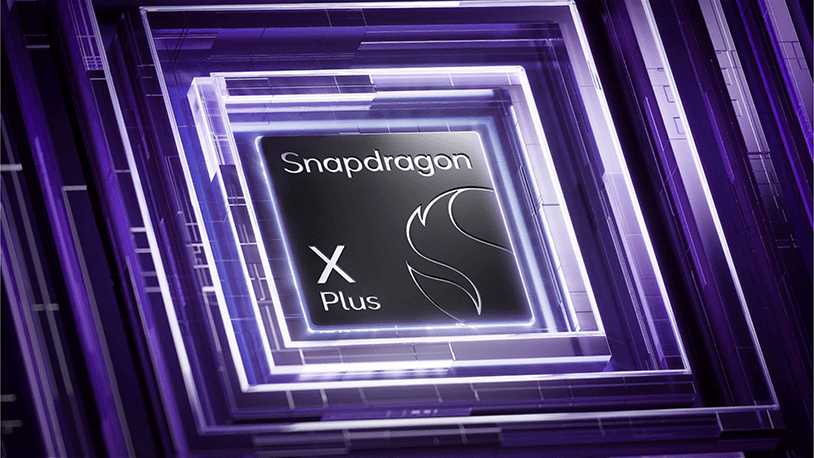
Amon’s comments come after his company announced the Snapdragon X Plus 8-core processor on Wednesday ahead of the IFA conference in Berlin.
Aimed at mid-tier computers, the AI-centric chips join the Snapdragon X Series of produts and are expected to massively boost AI adoption on PCs and laptops.
The also come at a strategic time to challenge Intel’s PC market dominance amid the latter’s ongoing chipmaking woes.
Microsoft’s CoPilot AI solution will remain integral to the success of the Snapdragon X Plus 8-core, namely after the Redmond, WA-based firm released its latest Surface devices, consisting of a new laptop and Pro tablet, with a Snapdragon X Elite chipset.
At the time, Amon told CNBC in a separate interview that Qualcomm aimed to diversify its family of solutions away from mobiles and into PCs, along with working with automakers for their AI semiconductor solutions.
He told CNBC on Wednesday: “We are on a journey to diversify and make sure our technology is now expanding into other markets.”
A Tactical Retreat for the Coalition?
The developments follow the ongoing mixed reality partnership with Google and Samsung, which had been initially rumoured to develop separate MR headsets using Snapdragon’s XR2+ Gen 2 processors.
At the time of the announcement, the coalition of tech giants aimed to produce products to rival the Apple Vision Pro.
D×M understands that, due to the Vision Pro’s underperforming sales, Qualcomm may pivot its collaboration to smart glasses, similarly to the Meta’s R&D shift to the upcoming Meta Quest 3S, now that it appears Apple’s headset no longer poses a threat to their market dominance.
One should note that Apple’s former Chief Finance Officer, Luca Maestri, transitioned to a new role in its Corporate Services team, effective 1 January of next year, following the low sales numbers, although it is unclear if there is a direct correlation between that and his reshuffle.
Furthermore, Qualcomm may aim to develop AR2 Gen 1 use cases as many tech analysts suspect that AR smart glasses could become the next major computing platform in the near future, replacing the smartphone.
Whilst Google and Samsung have yet to produce their headsets, the largest market share by far remains in the hands of Meta Platforms to date. Despite a 67.4 percent decline year-over-year in the first quarter 2024 (Q1 2024) for global VR/AR headsets, Meta captured roughly 64 percent of the total XR market, Counterpoint Research noted in a recent report.
Mark Zuckerberg, Founder and CEO, Meta voiced these sentiments in a fireside chat with Jensen Huang, Founder and CEO, NVIDIA at the SIGGRAPH 2024 in late August. The comments could signal a trend in the tech industry to move to smaller form, functional smart glasses rather than pouring research and development (R&D) funding into large-scale headsets such as the now-defunct Meta Quest Pro 2 and others.
D×M Waffle on Snapdragon Wins, Intel Losses
It also appears that Amon hopes to build Qualcomm into a PC chipmaker in addition to mobile to boost sales opportunities.
Due to the ongoing tech crisis, many cash-strapped enterprises are working to diversify their portfolios with existing solutions, and Qualcomm is no exception. With limited R&D, they may also prefer to innovate without pouring in massive funding into new capital-intensive projects.
Qualcomm will remain a leader in its near ubiquitous smartphone technologies until a major competitor arrives. However, regarding PCs, it has the potential to capitalise on Intel’s recent stumble in the semiconductor market.
Intel’s recent big reveal saw investors sell off its stocks in droves, leading to a 34.6 percent nosedive in value following its Q1 2024 earnings call. Additionally, it saw a one percent drop in revenues, an adjusted Q3 forecast by $1bn, and a $7bn loss across 2023 for its chipmaking division.
This is, of course, after it received financial backing from the US government’s CHIP Act, which awarded the firm up to $8.5bn in funding and potentially $11bn in loans from the linked 2022 CHIPS and Science Act.
Despite the financial assistance aimed at bringing overseas US manufacturing bases back to its borders and build two new semiconductor fabs in Ohio, Intel pushed their completion back to late-2026, citing funding struggles and chip demand, reports show.
Adding to the massive concerns, the company laid off over 15,000 staff, or 15 percent of its workforce, to save $10bn in costs for the 2025 fiscal year.
In a 2022 conversation with Brian Vogelsang, AR Product Leader, Qualcomm, I learned that the company had found a new category for its product lineup: AR smart glasses tethered to smartphones.
Along with developing hand, eye, and position tracking for physical environments, Vogelsang added that the two interlinked devices could “synchronise seamlessly.” He added at the time that tethered devices on the Snapdragon processor platform included the Lenovo A3.
Fast-forward to nearly two years later, and Qualcomm’s plans to push the Snapdragon AR2 Gen 1 platform are all systems go. The company’s work with Meta’s Ray-Ban series has provided enough emperical data for its generative AI capabilities, and is expected to reflect future innovations with Google and Samsung. Furthermore, market trends are shifting to smart glasses as many of the latest headset releases will satisfy high-powered consumer and enterprise XR head-mounted display (HMD) requirements for the next few years, as seen with the Quest 2.
What is Meta’s ‘Puffin’ project? Just that: a lightweight, Snapdragon-enabled MR device with a tethered puck to offload weight, compute, and battery from the user’s head — which will likely tease audiences at the Connect 2024.
Timing is everything.
Like this article? Be sure to like, share, and subscribe for all the latest updates from DxM!




 Deus×Machina
Leave a comment