
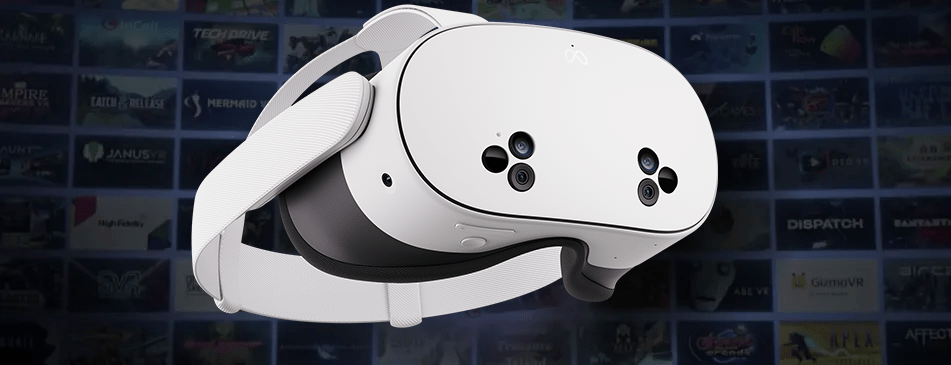
Meta’s cost-friendly version of the Meta Quest 3 has surfaced on global media, revealing renders of the device, reports revealed on Sunday.
First reported by UploadVR and citing a post from Reddit user u/Gary_the_mememachine, the post claims that the latter found the render “in the files of the Oculus Link client.”
The Link client allows for Meta Quest devices to connect to Windows computers via the Windows Meta Quest Link app.
One can confirm the leak by visiting C:\Program Files\Oculus\Support\oculus-dash\dash\data\js\assets\src\apps\dash\asset_files\experience-panels on the Windows-based programme.
Meta Quest 3s Specs
Responding to a question from a fellow Reddit user in the discussion thread, Gary_the_mememachine explained,
“From this tweet, apparently it’ll have 4 tracking cameras (2 on the front, 2 on the side), 2 color passthrough cameras, and 2 IR illuminators (for depth sensing). Using the IR illuminators instead of an actual depth sensor is a lot cheaper, which makes sense for a budget headset like this”
The tweet references X user @Lunayian, who claims to have “seen multiple devkits and spoken to several people familiar with the device.”
Specs listed in the infographic include:
- a Qualcomm Snapdragon XR2 Gen 2, similarly to the Quest 3
- an LCD display with an 1832 x 1920 resolution per eye, or 20 PPD, and 90Hz to 120Hz refresh rate
- Fresnel lenses with an interpupillary distance (IPD) adjustor
- A spacer for prescription glass wearers, similarly to the Meta Quest 2
- Meta Quest 2 touch plus controllers
- Automated Space Setup, inside-out body tracking, and multimodal tracking
The leak comes ahead of the Meta Connect event on 25 September, where executives from the Menlo Park-based firm are set to unveil a trove of new devices, solutions, and upgrades to its family of products.
The Meta Quest 3s will likely mark its debut at the event with an October release date, similar to the Quest 2, Quest 3, and Quest Pro.
D×M Waffle on the Meta Quest 3S ‘Recycling Programme’
So, looking under the hood of the headset, Meta seemingly wants to launch a device aimed at cost and accessibility, rather than top specs.
One of the best aspects of the Quest 2 was that it stood the test of time from October 2020 until its gradual phasing out this year, or roughly four years later. However, it’s still a widely-used headset across the industry.
Additionally, what works in favour of the Quest 3s is its balance between old and new supply chains from the Quest 2 and Quest 3.
If @Lunayian’s specs are correct, the Quest 3s is simply the Quest 2 with an updated processor, moving from the Snapdragon XR2 Gen1 to the XR2 Gen2.
Upgrading to the Gen2 on the Quest 3s will offer a huge boost to Qualcomm sales, but also leverages older technologies such as its legacy controllers from the Quest 2, clearing out former inventory and scaling production of the accessory gradually for 3s unit sales.
It will also use similar displays to the Quest 2, which are (drum roll) fast-switch LCD displays at 1832 x 1920 resolution per eye, according to the Quest 2 website, compared to the Quest 3’s 2064 x 2208 resolution. However, the 120Hz refresh rate comes standard in the 3s, whereas it was an experimental feature on the Quest 2 found in the Horizon menu.
The Quest 2’s Fresnel lenses are now in the Quest 3s as well, along with a cheaper time of flight (ToF) depth sensor. Conversely, the Quest 3 incorporates more efficient and slimmer pancake lenses and a more accurate infrared (IR) line projector, similar to Apple’s LiDAR technologies.
Passthrough, however, will remain in colour similarly to the Quest 3 to provide continuity with Meta’s current catalogue of best-selling games and tools, phasing out its black-and-white passthrough from the Quest 2.
Meta has also swapped the Quest 2’s single top strap in the 3s for the Quest 3’s Y-shaped headband for better ergonomics.
So the 3s is basically the best of both worlds. It allows Meta to efficiently clear out old inventories of components to purge its legacy stocks. The form factor, technologies, and ergonomics are relatively Quest 2 with a Quest 3 nudge.
This is why phasing out the Quest 2 makes sense, because the legacy components can simply receive a few simple updates to keep the device current with the times, yet adhere to Meta’s Year of Efficiency pledge.
It is, of course, all the better as Meta can focus on increasing market shares, reducing research and development (R&D) costs by recycling components, and it doesn’t need to spend money to develop the Quest Pro 2 and face potentially underwhelming returns on investment (ROIs) as seen with the Apple Vision Pro.
Anyone who has made ramen with leftover veg in the fridge will understand this. Still hits the spot, but it clears the fridge for a new shop.
Like this article? Be sure to like, share, and subscribe for all the latest updates from D×M!



 Deus×Machina
Leave a comment