
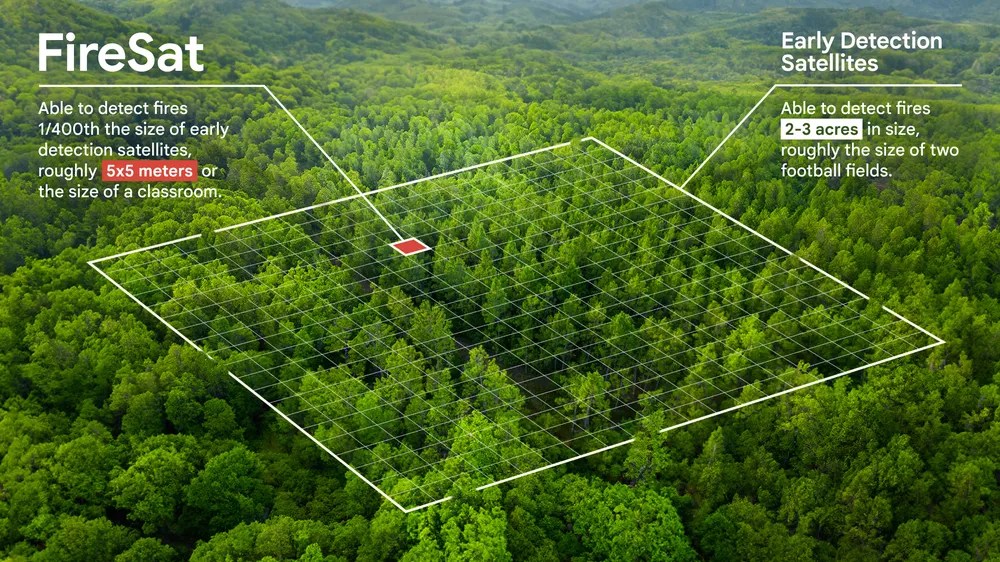
Google has joined forces with firefighters worldwide to launch a cutting-edge solution dedicated to early fire detection — from space.
In a press release, Google explained that its FireSat satellite constellation would become the latest tool in the firefighter’s arsenal.
Using high-resolution imaging, Google Researchers could pinpoint a wildfire’s location to the size of a 5 x 5 classroom. Previous monitoring capabilities could only spot larger fires two to three acres wide with low-resolution legacy tools.
FireSat updates its visual data every 20 minutes, allowing first responders to deploy to wildfire sites and resolve potentially life-threatening flareups.
Google.org funded the Earth Fire Alliance initiative with $13m, along with backing from the Moore Foundation. Google Research also partnered with the Environmental Defense Fund and Muon Space to develop the solution.
Using bespoke infrared sensors, the satellites leverage artificial intelligence (AI) to compare and contrast new ground imagery, infrastructure, and weather to detect fires in monitored areas.
The project also used controlled fires to gather sensory data, paving the way for Muon Space to deploy its maiden satellite voyage at the beginning of 2025. Further satellite launches will complete the constellation in due course to activate the solution’s full efficacy.
Not only will the solution quickly detect wildfires, but it will also help to understand their behaviours, including movement, spread, and conditions, with the help of the US Forest Service, Google explained.
Currently, Google has used its AI models to track and inform people of wildfires across more than 20 countries.
This also includes its open-source machine learning benchmark dataset, FireBench, to train AI tools in the fight against natural disasters. It is Google’s biggest dataset for simulating wildfires.
Fighting Fire with FLAIM
Stories like this are inspiring for the next wave of first responders, namely as they leverage immersive and emerging technologies to fight fires with tactics inaccessible to previous generations.
Initially learning about this a few years back, I interviewed several industry leaders about how their innovations prepared firefighters to tackle challenging situations when responding to emergency sites.
At the time, Kevin Sofen, Business Develop Manager, Darley, Logan Parr, then-Director of Marketing and PR, Pico, and Cpt Kirk McKinzie, President, McKinzie Smart Technologies, explained how their XR tools saved first responder lives, funding, resources, and deployment times.
With FLAIM and RiVR, two fire researching and simulation enterprises, Darley could help advance firefighter training with its immersive all-in-one solutions, allowing students to train “anytime, anywhere.”
Parr added then that the COVID-19 pandemic had forced many departments to employ VR training, as most required remote work and continuous upskilling while battling the pandemic.
Ultrafast 5G, Ultrafast First Responders
Additionally, major telecom providers like Nokia explained how their 5G solutions enabled industrial metaverse platforms capable of similar fire-monitoring solutions.
For examples, firefighters using robots, drones, 360-degree videos, internet of things (IoT) devices, and 3D spatial audio could tackle blazes with pinpoint accuracy using the firm’s ultrafast, low-latency 5G networks.
5G infrastructure could also monitor firefighters’ real-time locations, feed data to augmented and mixed reality (AR/MR) headsets, and monitor vitals whilst tackling emergencies, providing more effective decision-making insights in difficult or risky scenarios.
Companies like Longan Vision have also provided augmented reality (AR) displays attached to firefigher helmets that can detect fires, people, and objects with infrared computer vision in their heads-up displays.
With Google, the Mountain View-based firm is no stranger to widespread fires. Currently, fire brigades are battling three huge blazes across Southern California, with Fred Fielding, Spokesperson, Los Angeles Fire Department noting they were the “most dramatic over a single day period.”
The company’s contributions to fighting the dangerous natural disasters with next-generational tools are just the beginning to improving quality of life for citizens worldwide to save lives, in addition to critical flora and fauna in natural environments.
Like this article? Be sure to like, share, and subscribe for all the latest updates from DxM!


 Deus×Machina
Leave a comment