
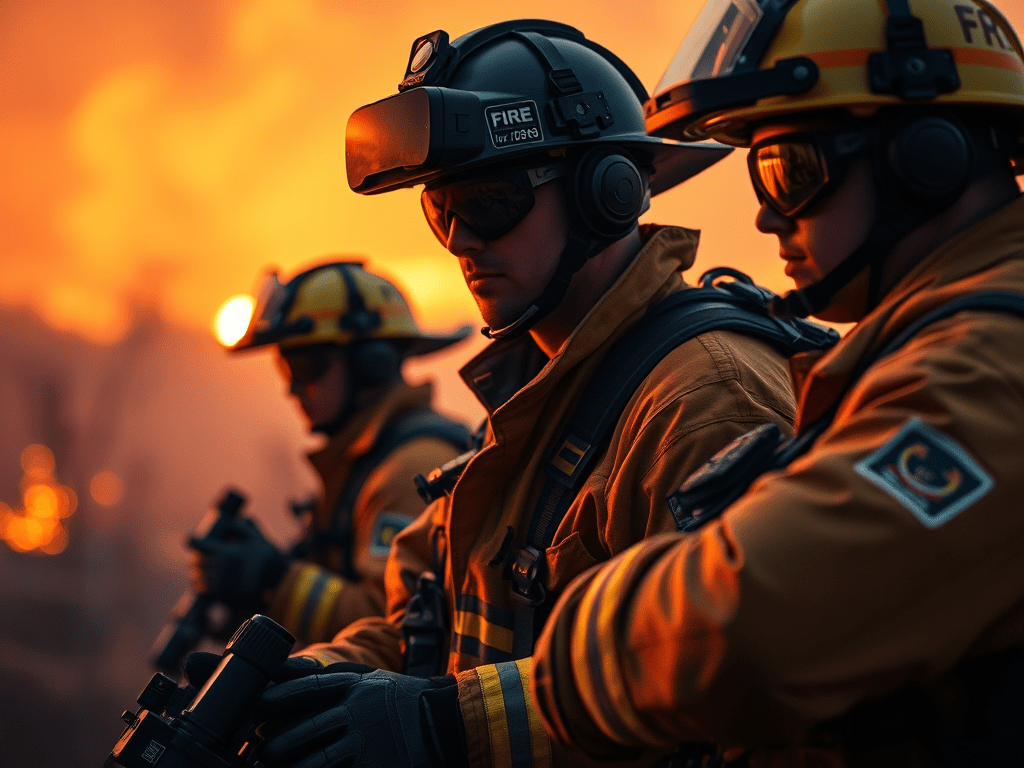
The United States House of Representatives passed a new bill on Tuesday effectively encouraging the deployment of emerging technologies across firefighting technology stacks.
Introduced by Rep Bruce Westerman [R-AR-4], the Fix our Forests Act [HR 8790] states that it aims to,
“give priority to covered entities developing and applying emerging technologies, including artificial intelligence, quantum sensing, computing and quantum-hybrid applications, augmented reality, and 5G private networks and device-to-device communications supporting nomadic mesh networks, for wildfire mitigation.”
Joan O’Hara, Senior Vice President of Public Policy, XR Association (XRA), said that her organisation was “encouraged” to see that the bill “specifically highlights augmented reality” in the technology stack.

The technologies listed aimed to support staff in fighting wildfires, improving forest management, boosting community resiliency, and backing first responders, she added.
She explained further,
“To date, the 118th Congress has introduced more than 20 bills that call on immersive technology (XR) to address a wide variety of challenges, including climate and ecological concerns. With nations around the world, including China, investing heavily in XR, it has never been more important for the U.S. to recognize the power and potential of this transformative technology.”
She concluded that taking such steps would ensure the United States would remain “the world’s technology leader.”
“XRA looks forward to continuing to collaborate with policymakers on future legislative and educational initiatives to advance the industry,” she concluded.
According to documents
Latest Developments in XR Fire Safety Training
News of the statement comes after researchers and companies reached several major milestones in the fight against wildfires caused by human error, arson, or reported climate change.
For example, Google unveiled a groundbreaking FireSat satellite constellation solution to detect fires as small as 5 square meters.
In September, Google announced the tool would massively boost detection capabilities with high-resolution satellite imaging, AI, and timely 20 minute updates, compared to previous systems.
For the initiative, Google partnered with the Earth Fire Alliance by contributing $13m in funding, and received further support from the Moore Foundation, Environmental Defense Fund, and Muon Space.
Thorne Fire and Security also rolled out a training course for end users and customers on escaping life-threatening fire scenarios.
Using virtual reality (VR), learners demonstrated higher retention rates of learned evacuation strategies, levels of engagement, and performance in using safety tools.
The Nelson-based company’s programme also provided trainees with feedback on responses and documented key performance indicators (KPIs) when faced with emergency situations while also allowing full module retraining on-demand when necessary.
Thorne’s developments support research from the Te Kunenga ki Pūrehuroa Massey University in New Zealand, who tested subjects using augmented reality (AR) to train in fire safety, boost engagement, and improve learner retention rates in the short and long-term, compared to video training.
Firms continuing to lead the way in fire and safety technologies include Britain’s RiVR, US-based Darley, and Canada’s Longan Vision, and more.
Like this article? Be sure to like, share, and subscribe for all the latest updates from DxM!




 Deus×Machina
Leave a comment