
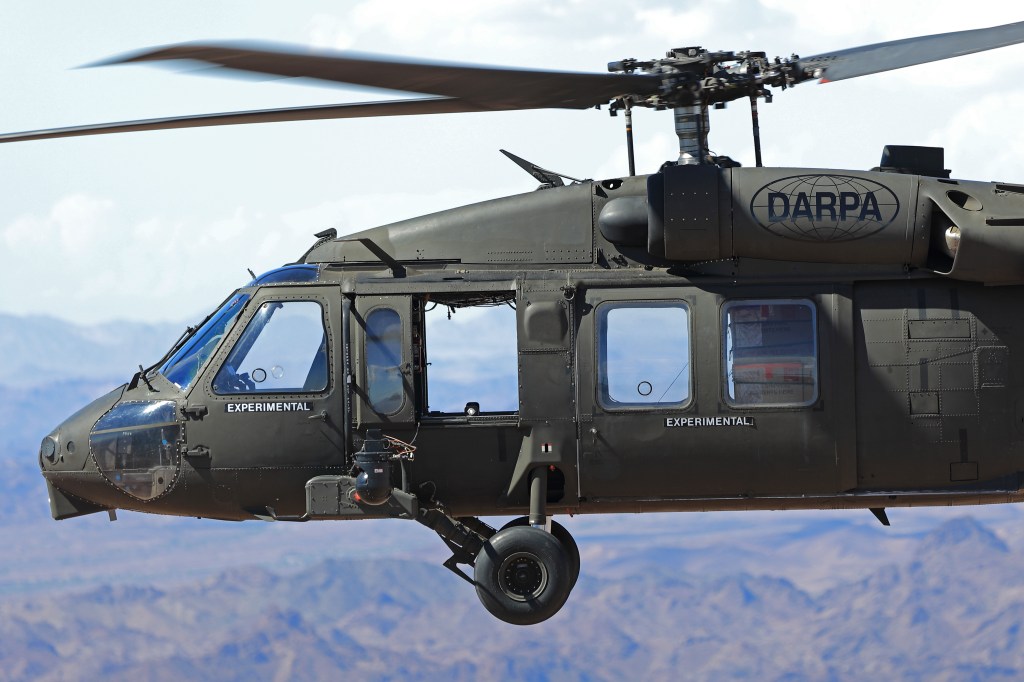
The Defense Advanced Research Projects Agency (DARPA) has awarded Lockheed Martin subsidy Sikorsky a massive $6m in funding to advance its autonomous flight system for Black Hawk helicopters.
Announced on Monday, Sikorsky will use the funding to install its ALIAS/MATRIX autonomous flight systems on US Army UH-60M Black Hawk helicopters, allowing them to fly with a single pilot or fully unmanned.
The US Army Combat Capabilities Development Command (DEVCOM) will carry out rigorous testing and evaluations for the ‘pilot’ project.
DARPA’s Aircrew Labor In-cockpit Automation System (ALIAS) programme is powered by its artificial intelligence (AI)-based MATRIX automation core, with Sikorsky engineers developing the system to enhance MX flight capabilities.
READ MORE: Why Has Palmer Luckey’s Anduril Stepped into the US Army IVAS Project?
According to the firm, the MATRIX and ALIAS autonomy systems will operate synchronously to pilot MX helicopters from 2025 onward.
Doing so will provide DEVCOM with critical feedback to grow, enhance, and boost the system’s autonomous flight capacity at scale, including sensor assessments, threat detection and avoidance, among others.
The news comes after Sikorsky and DARPA teams demoed Optionally Pilot control systems to US military officials via tablets and solo flights.
Work on the latest programme comes after a further demo at the Project Convergence 2022 event demonstrated unmanned flight competencies, including refuelling and cargo supply missions, on Optionally Piloted Black Hawk helicopters.
Rich Benton, VIce President and General Manager, Sikorsky, explained further that,
“Autonomy-enabled aircraft will reduce pilot workload, dramatically improve flight safety, and give battle commanders the flexibility to perform complex missions in contested and congested battlespace, day or night in all weather conditions. Soldiers will rely on Black Hawk helicopters into the 2070s, and modernizing the aircraft today will pay dividends for decades across Army Aviation’s current and future aircraft.”
The announcement comes just a month after defence firm Northop Grumman leveraged virtual and augmented reality (VR/ AR) to design and simulate intercontinental ballistic missile (ICBM) target vehicle scenarios.
The project aims to limit risk and improve testing outcomes for its Aegis and Midcourse Ballistic Missile Defense systems. Using spatial technologies, the company can streamline pathfinding field operations for advancing military assets on the battlefield.
Like this article? Be sure to like, share, and subscribe for all the latest updates from DxM!



 Deus×Machina
Leave a comment