
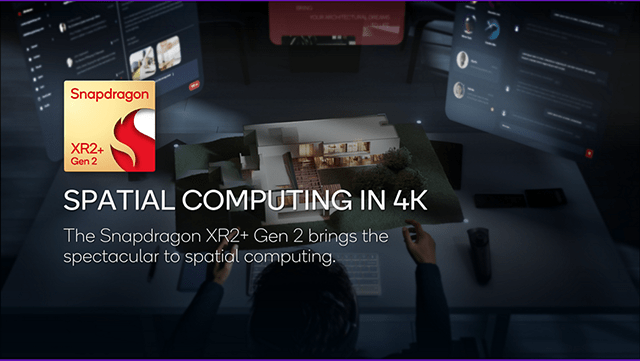
Big news has been announced at Qualcomm after the company revelaed it would partner with Google and Samsung to promote its Snapdragon XR2+ Gen 2 Platform.
In a press release, the San Diego-based tech giant unveiled plans to debut the “single chip architecture” capable of massive compute power.
The company noted it could leverage its compute architecture for 4.3 spatial computing, clocking at 90 frames per second, to offer users high-fidelity visuals.
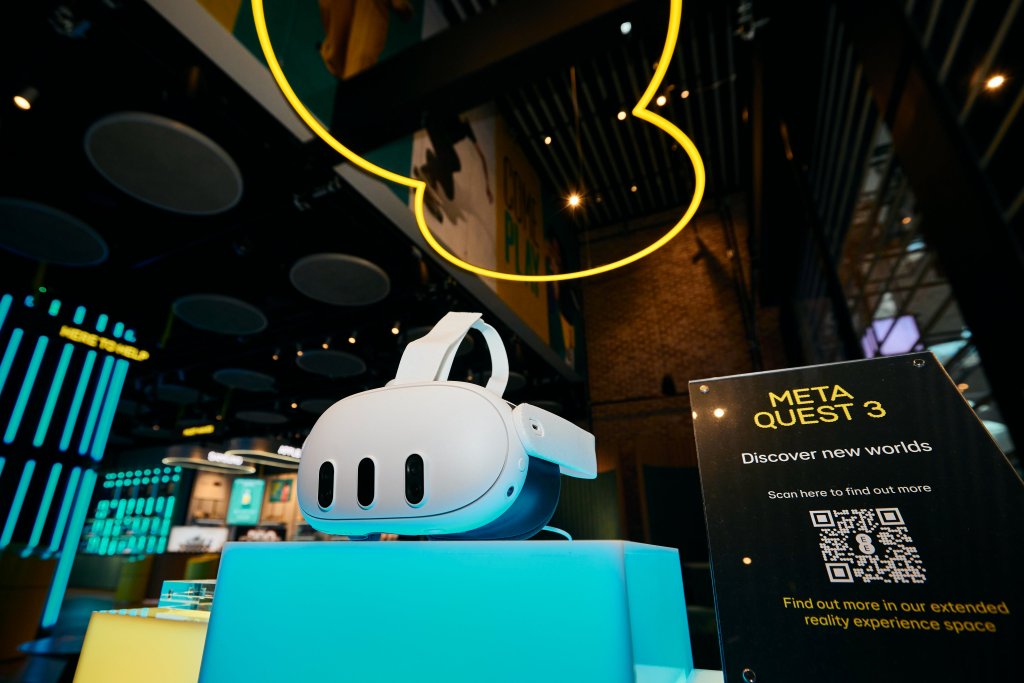
Currently, the Meta Quest 3 uses Qualcomm’s Snapdragon XR2 Gen 2 along with its novel specifications and features. However, the new system’s “+” will usher in a new era of cutting-edge graphics, benefitting virtual and mixed reality (VR/MR) devices.
According to the company’s stats, the Snapdragon XR2+ Gen2 will boost graphics processing unit (GPU) performance by 15 percent, and computer processing unit (CPU) capabilities by roughly 20 percent.
It will also back back processing power for “12 or more concurrent cameras” using its fully-capable, onboard AI features, leading to faster hand, eye, and motion tracking, and enhanced MR functionality.
Furthermore, the components manufacturer created an innovative VR/MR reference design, which Goertek, an equivalent Chinese component manufacturer, developed for the Qualcomm.
Additionally, the new design will incorporate Finnish hand and eye tracking firm Tobii’s next-gen tracking eye tracking technologies, allowing 3K per eye resolutions on the Snapdragon XR2 Gen 2 and 4K per eye resolutions on the “+” edition of its MR computing platform.
Comments on Qualcomm-Google-Samsung Partnership
In a statement, Hugo Swart, Vice President and General Manager of XR, Qualcomm Technologies, said,
“Snapdragon XR2+ Gen 2 unlocks 4.3K resolution which will take XR productivity and entertainment to the next level by bringing spectacularly clear visuals to use cases such as room-scale screens, life-size overlays and virtual desktops.”
He added: “We are advancing our commitment to power the best XR devices and experiences that will supercharge our immersive future.”
Inkang Song, Vice-President and Head of Technology Strategy Team, Samsung Electronics, expressed his sentiments about the Samsung-Qualcomm partnership.
He said,
“Samsung is thrilled to collaborate with Qualcomm Technologies and Google in revolutionizing the mobile industry once more.” Inkang Song, vice president and head of technology strategy team at Samsung Electronics, expressed his excitement.”
Concluding, Song said: “With Samsung’s mobile expertise and our joint commitment, we aim to create the best-in-class XR experience for Galaxy users.”
Finally, Shahram Izadi, Vice-President of AR, Google, said,
“We look forward to continuing our collaboration with Qualcomm Technologies and Samsung on the future of immersive and spatial XR.”
He added: “We’re excited for the Android ecosystem to take advantage of Snapdragon XR2+ Gen 2’s capabilities and enable new experiences.”
Analysis of Snapdragon Partnership
Hello, everyone. This is big, big news from Qualcomm, and its recent partnership with Samsung and Google indicates a strong move to reposition itself in the XR market.
Learning from the mistakes of last year and before, Qualcomm is now stepping up its efforts to create solid viable partnerships with some of the world’s biggest tech firms.
Currently, Qualcomm’s stocks have oscillated between profit and loss over the last few quarters, with recent quarterly reports revealing overall losses in three key areas.
To start, Qualcomm has seen profits fall in the quarter ending 30 September 2023 to $8.631bn, or a 24.26 percent drop year-over-year (YoY).
Additionally, twelve-month revenues for the company ending in the same period totalled $35.820, or an 18.96 percent decline.
Working with Google and Samsung will secure quite a bit of market share in North America and Asia, respectively, by partnering with these two tech giants that carry massive research and development (R&D) capabilities.
What I can see from this partnership is Qualcomm allowing Google and Samsung to develop their next generation headsets by removing much of their R&D costs, and additionally, working with these partners to develop their headsets over the next few years in the market.
This puts them in direct competition with Apple, as noted in many reports across the world, including The Verge and CNBC. But additionally, this helps Qualcomm to cement its computing empire in the XR market, which I think it desperately wants to accomplish and achieve.
Knowing that the Apple Vision Pro is just weeks away from being released in the markets, Qualcomm is aware of serious competition at the technological and market level, despite the latter’s massive price tag.
Furthermore, Apple has revealed it plans to launch a second generation mixed reality device at a lower price, along with a future set of augmented reality smart glasses. The company’s M2 processor and R1 co-processor are reportedly a formidable compute force to be reckoned with.
This could stir the pot for many competitors in the XR market, as there is now genuine competition between rival firms and alliances are forming.
Apple is, in its own right, still the largest tech company in the world with over a trillion dollars in valuation, and if Qualcomm wants to survive, it will need to form these alliances with companies that have the capabilities to leverage their own artificial intelligence (AI), proprietary technologies, and other tools at their disposal to help continue competing in the XR market.
Like this article? Be sure to like, share, and subscribe for all the latest updates from DxM!



 Deus×Machina
Leave a reply to Qualcomm Alliance to Pivot to Mixed Reality Smart Glasses, CEO Says – Deus×Machina Cancel reply