
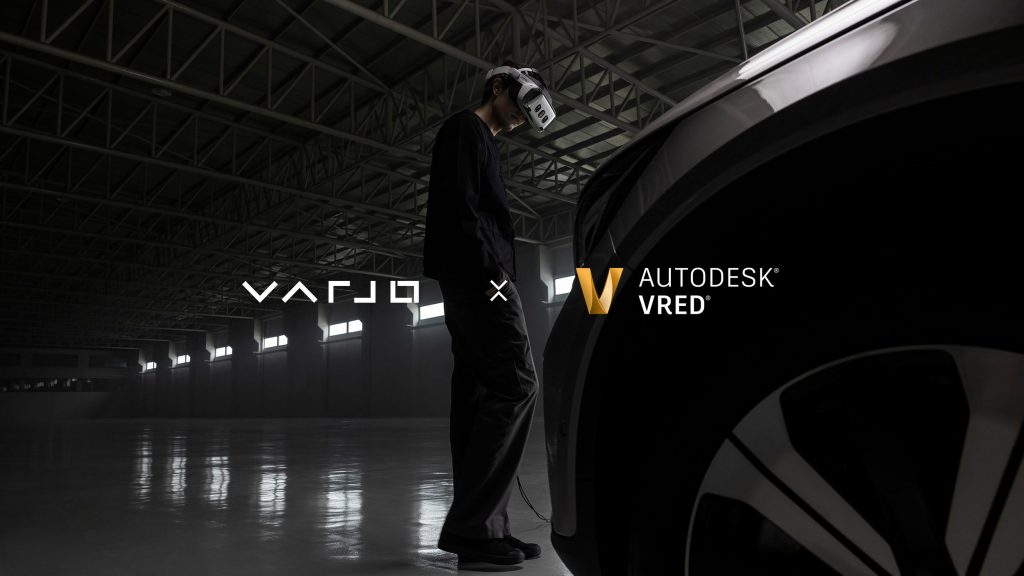
Finnish virtual and mixed reality (VR/MR) company Varjo announced this month that its platform natively backs Autodesk VRED 2025.1 for use on the Varjo XR-4 series headset.
Now, people across industry verticals using Varjo’s flagship headset can tap Autodesk’s cloud computing XR platform for their workflows.
Designers, engineers, and others can now leverage the world’s most advanced XR head-mounted displays (HMDs) for their projects, advancing the use of immersive solutions for a multitude of use cases.
The Varjo-VRED Connection
With Varjo’s forward-thinking hand-tracking, depth occlusion, and QR code technologies, designers can usher in a new age of photorealistic content.
For example, the automotive industry has benefitted tremendously from such tools, with Varjo recently partnering with Rivian to design fleets of their next-gen vehicles.
Through Varjo and Autodesk VRED, users can incorporate the platform’s hand-tracking tools to interact with digital content, LiDAR and depth estimation for cutting-edge spatial awareness, and Varjo Markers, which anchor digital content to the real world, blending the two realms seamlessly.
Additionally, Varjo’s XR-4 headset can also toggle VR and MR, depending on the context of digital content, and implement foveated rendering to focus processing power on the pixels viewed by users in real-time, saving system resources for a smooth, fluid immersive experience.
Finally, Varjo’s eye-tracking tools work in tandem with iMotions and other analytics software to calculate user behaviour. Building on previous solutions centred on the attention economy, this provides immense insights into human psychology to improve digital content and asses user interactions with digital assets.
Lukas Fäth, Sr Manager of Product Management, Automotive Visualisation and XR, Autodesk, explained that he was “excited” to back the partnership.
He continued,
“This integration brings a new level of realism and interactivity to automotive design, engineering and marketing, enabling our users to visualize their ideas with unmatched precision and depth.”
Furthermore, Miika Jokinen, Head of Software Partnerships, Varjo, added that the partnership “exemplifies our commitment to providing the most advanced mixed reality tools for our enterprise users.”
He added:
“With the Varjo XR-4 Series support of VRED 2025.1, automotive designers can push the boundaries of what’s possible, creating more detailed, accurate, and immersive designs than ever before.”
A Recap of the Varjo XR-4
Standing on the shoulders of giants, Varjo’s XR-4 headset launched back in late-November last year. The product debut showcased arguably the world’s most advanced device to date, which arrived in several editions — the XR-4, the XR-4 Focal Edition, and XR-4 Secure Edition.
At the time of its release, Patrick Wyatt, Chief Product Officer, Varjo, said that, amid the “period of rapid expansion in [MR] adoption,” his company was “proud” to push the industry forward by “bridging the gap between human vision and computer vision” via the XR-4 series of headsets.
Additionally, the headset boasts the following specs:
- Dual 4K x 4K displays at 51 pixels per degree (ppd)
- More than 50 percent wider field of view (FoV) at 120 degrees x 105 degrees compared to previous generations
- Double the brightness at 200 nits and greater colour gamut at 96% DCI-P3
- Dual 20 Mpx camera for unparallel high-fidelity photorealism with real-time MR passthrough
- Ambient light sensors and an eightfold improvement in LiDAR resolution over the XR-3
- Integrated DTS 3D spatial audio and noise-cancelling microphones
- Razer-powered Varjo Controllers with inside-out tracking for precision movements and tactile feedback
- NVIDIA RTX Ada Generation GPUs for intuitive integrations on the NVIDIA Omniverse for OpenUSD-based application development.
- Varjo Reality Cloud streaming of projects for fully-interoperable, accessible 3D workflows to all within the product workflow.
Through these, Varjo aims to recreate human sight with the impeccable visual fidelity, which are nearly indistinguishable from human sight.
Some of the most visually advanced use cases of its technologies comes from its Teleport solution, which recently digitally twinned Piccadilly Circus using wholly immersive gaussian splattering and machine learning (ML) tools to scan, recreate, and showcase London’s iconic landmark.
According to the Helsinki-based firm, more than 25 percent of Fortune 100 enterprises train aerospace, medical, automotive, and architectural, engineering, and design (AEC) professionals via their solutions.
NVIDIA’s industry-leading graphical processing units (GPUs) power the technologies behind the NVIDIA Omniverse, which supports Varjo’s lifelike rendering complete with ray tracing and seamless interoperability.
Like this article? Be sure to like, share, and subscribe for all the latest updates from DxM!




 Deus×Machina
Leave a reply to VRARA Enterprise Summit 2024: What Are the Top XR Tech Trends? – Deus x Machina Cancel reply