
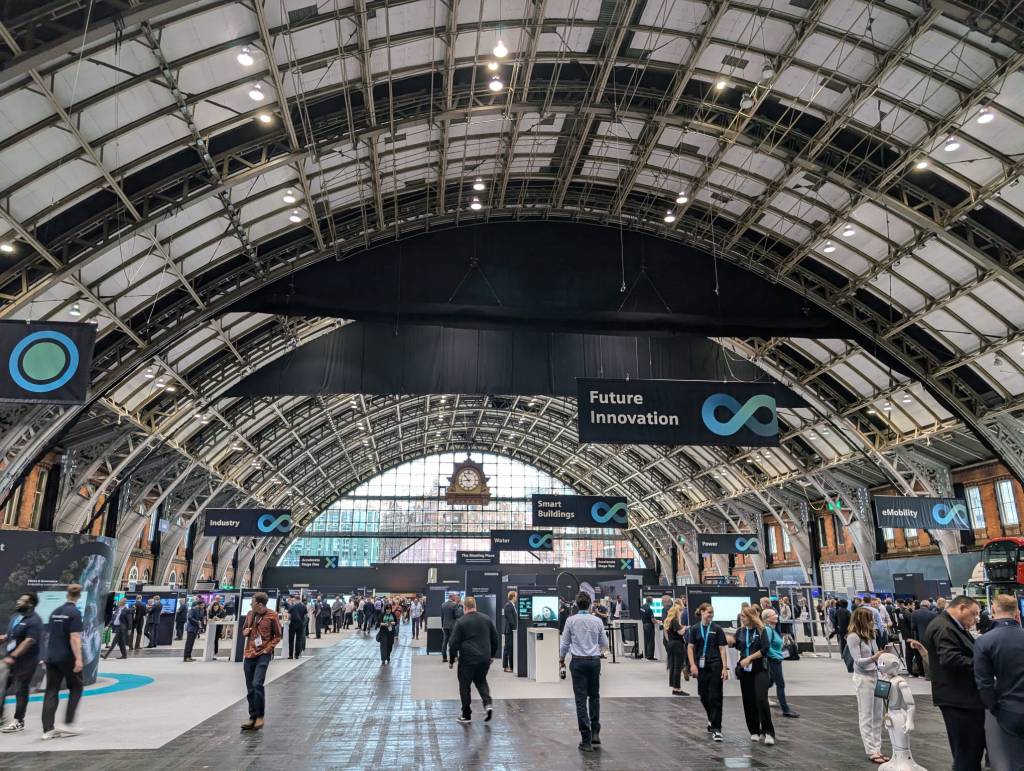
Siemens’ work in multiple industry verticals has shaped with it an immense number of use cases and arguments for the industrial metaverse, a series of interconnected data sets used to simulate real-world engineering projects ahead of their production.
With these formidable tools, Siemens and its partners have blossomed a host of scientifically-driven projects developed under the industrial metaverse ranging from automotive, smart city, and aerospace and defence.
DxM spoke to Doug Brown, Pre-Sales Digital Solutions Consultant, Siemens PLM Software. The executive is currently developing Siemens’ NX portfolio, along with its design and simulation solutions, to support enterprises in developing their products with cutting-edge and mathematically-driven digital twin simulations.
DxM: Can you tell me some of the benefits of simulating products in the industrial metaverse ahead of production?
Doug Brown: To begin, I can share some of my industry experience prior to joining Siemens, where I was very much involved in design reviewing.
During the division of digital development stages for the automotive industry, I often found we would have discussed problems found early on using screenshots — 2D images — of 3D computer-aided design models.

These could be quite difficult to convey messages and enable more senior management people to understand issues, because you’re trying to illustrate a 3D scenario simply from a 2D snapshot.
Using VR solutions similar to those embedded in products like NX, we now have plug-and-play capabilities that really enable more of an immersive experience for digital design reviews.
Rather than trying to interpret messages with 2D screenshots, engineers and managers can immerse themselves in that environment, not only to understand raised concerns but also to develop more compelling countermeasures with greater understanding of their efficacy.
That can make communication for those scenarios much more efficient and expedient to support the digital development process.
At the Transform 2024 event, we’re showcasing our partnership with Aeralis, a startup aerospace and defence company, that has provided 3D representations of their aircraft used in wind tunnel simulations, revealing the connected digital thread adopted to develop their products.
These are a connected set of diverse solutions, and, along with the NX design tool, they’ve built up the aircraft’s structures in a connected, associative manner.
As that progresses, Aeralis can take that data — the computer-aided design (CAD) digital representation of their product — and move that into our simulation capabilities.
Specifically here, we’re looking at Siemens’ Simcenter STAR-CCM+ [computational fluid dynamics] software, or their Simcenter Portfolio, giving us a representation of the airflow around the aircraft.
Moving forward, we also have virtual reality (VR) embedded within that, allowing the user to immerse themselves again in the CFD world using controllers to create digital smokesticks, understand airflow paths around the aircraft, and see areas of detail where we can scale up the model.
This provides insights into how airflow will move around different features of the aircraft in ways not seen in the physical world. [It] also enables users to really immerse themselves in the virtual environment and learn how their products will perform at the early digital stages.
What we’ve done with Aeralis is support them as they develop their products with a lot more [robust] factual data and efficiency, especially when producing the aircraft seen here today.
DxM: Regarding prototyping and CFM simulations, how do these virtual representations help to deliver a shorter time-to-market?
Doug Brown: One example I remember moves away from the aerospace and into virtual commissioning, which really fits the theme here at Transform 2024.
At Siemens, this is our NX Mechatronics Concept Designer (NX-MCD), which operates like a machine builder’s tool. [Without such tools] it can be an intensive process, where a lot of commissioning is done at the physical stage to detect problems, leading to time-consuming and costly impacts.
This is where I would have to go back to the digital stage to investigate any problems and update physical models. When we think about virtual commissioning, we try to do as much of that as possible with digital twins by representing the physical model in simulation.
Using NX-MCD, we can incorporate XR before machines are built. Our solution allows them to immerse themselves in that environment by putting on a VR headset, viewing the product, and understanding how the machines and sequencing behave before moving into the small, time-consuming, and costly fiscal stages.
If we find problems in the physical stages, it will no doubt affect qualities and similar issues. The more we can do in the early digital stages [of design], product quality can improve, shortening our time-to-market ahead of their physical production phase.
This also builds confidence with evidence and fact-based data that everything will work after the manufacturing process. Any problems we may find at that stage will just be small tweaks, rather than going back to earlier designs, to make fundamental changes.
Siemens Transform 2024
The interview comes as the Siemens Transform 2024 event takes place in Manchester from 17 to 18 July, uniting over 50 speakers and over 500 experts from across the infrastructure, software, and tech sector.
The Munich, Germany-based engineering firm has convened a strong roster of guests from across architecture, engineering, and construction (AEC), the industrial metaverse, aerospace and defence, smart cities, eMobility, and many, many more.
Experts involved in the Siemens Xcelerator programme have also showcased their digital transformation and solutions in a bid to transform industry verticals, leading to a more sustainable, future-proof industry.
Like this article? Be sure to like, share, and subscribe for all the latest updates from DxM!


 Deus×Machina
Leave a reply to How Northrop Grumman Uses XR to Boost Defence Readiness – Deus×Machina Cancel reply