
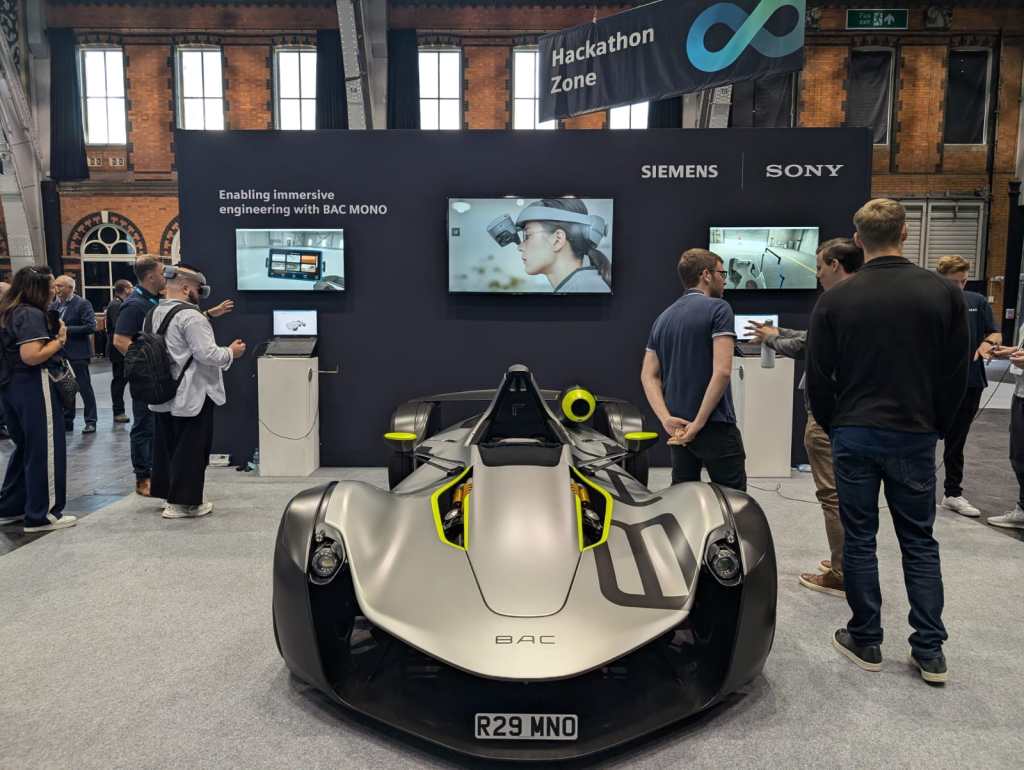
As the processes of manufacturing meet the global challenges of sustainability and innovation, Siemens has responded by unveiling a massive portfolio of use cases at a major event in Manchester.
The automotive industry continues to push further into engineering, breaking boundaries as well as reaching milestones in design, complexity, and most importantly, sustainability.
A specific use case has noted the role of immersive technologies in conquering challenges with modern-day engineering and design, leading to remote, real-time collaboration in the industrial metaverse.
DxM spoke to Ben Widdowson, Head of Marketing, Immersive Engineering, Siemens to discuss his company’s partnership with Sony and his role in facilitating their immersive metaverse venture via Siemens NX, a software suite for computer-aided design (CAD) and computer-aided manufacturing (CAM).

According to figures, Siemens NX has recorded up to 50 percent faster product design cycles, a 20 percent shorter time-to-delivery, and a 90 percent first-time yield for clients.
Speaking on the partnership, Widdowson explained it involved an immersive engineering suite of solutions, including the integration of “a new mixed reality headset from Sony” and novel immersive engineering software from Siemens.
He stated that Siemens announced it earlier in the year at the Consumer Electronics Show in Las Vegas, with the new product opening for sales to customers in December.
Widdowson told DxM that he was excited that the Briggs Automotive Company’s (BAC) brought their BAC Mono automobile with them to the event for the demo.
He explained further,
“What we have here is still ongoing. It’s their entire car data, with every nut, every bolt, and every washer inside Siemens NX. We can start to showcase that our designers and engineers can not only review the data, but do very meaningful engineering.”
Several of BAC’s use cases included customer-facing applications of the virtual car technology, where potential buyers could visit and “sit in a virtual car before it’s been built.”
Each visitor could view custom liveries on the exterior of the virtual model, and reposition the steering wheel, chair position, and foot pedals before the vehicle’s construction.
Design teams could also remain distributed between the United Kingdom and Germany, providing “collaborative design sessions” where the disparate groups could “jump into a review session” virtually.
Widdowson continued that, using Siemens NX, they could change virtual headlamp parameters “at human scale” whilst stakeholders were digitally present in the immersive space.
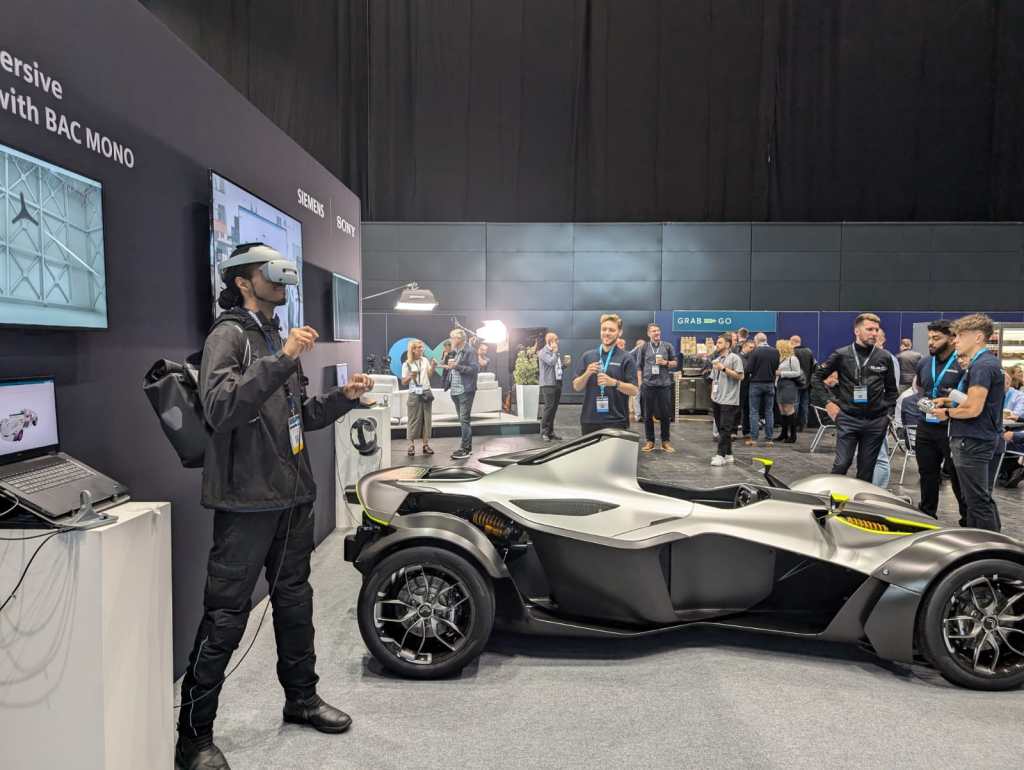
Stakeholders and teams could then analyse the changed positions and provide feedback in real-time to the designers.
He told DxM: “It’s really going to open up some of those really interesting use cases, I think.”
Siemens and Sony: Alleviating Data Pain Points
When asked about Siemens’ partnership with Sony and the benefits of using their novel headset in industrial metaverse use cases, Widdowson explained that firstly, it could help customers alleviate struggles with exporting their data into third-party applications, which was “time-consuming.”
He stated that users could launch “straight out of the engineering tool,” where they could benefit by reducing data preparation, securing data within the Siemens tool ecosystem, and providing a “live connection to the engineering tools.”
He continued,
“Any changes you make to the car data, updates, or additions go straight into the assembly in real time. You don’t have to re-export them or repeat the process.”
Siemens NX and the Potential for ROI
Finally, regarding the industrial metaverse and its return on investment (ROI), DxM asked Widdowson about the specific benefits he had seen for products before launch.
Broadly speaking on the industrial metaverse, the executive stated that a major advantage was that it allowed designers and engineers to do most of their “early design, simulation, and prototyping immersively before making any physical models.”
He concluded,
“Even the people at BAC — our customer showcase here today — were very familiar with their own products. They’ve been making them for over 15 years, and yet, the lead engineers were still blown away by being able to see their designs virtually. I think that early experience of doing these things virtually, before they’re physically made, really opens up that window into the industrial metaverse.”
The Siemens Transform 2024 event is taking place from 17 – 18 July and features a stellar showcase of the Munich, Germany-based engineering giant’s solutions across infrastructure, software, hardware, and the industrial metaverse, among others.
Several of its most esteemed highlights include the Siemens Xcelerator Marketplace, an ecosystem of partnerships and products working jointly to drive innovation, interoperability, and the industrial metaverse.
Digital transformation, sustainability, and developing the skills of future workforces has remained a central component of the event.
The company’s executives and partners also explored the current and future potential of smart cities, infrastructure, building information modelling (BIM), aerospace and defence, eMobility, and sustainability, among many others.
Like this article? Be sure to like, share, and subscribe for all the latest updates from DxM!



 Deus×Machina
Leave a reply to Bentley Systems Acquires Cesium to Boost 3D Geospatial Design – Deus×Machina Cancel reply