
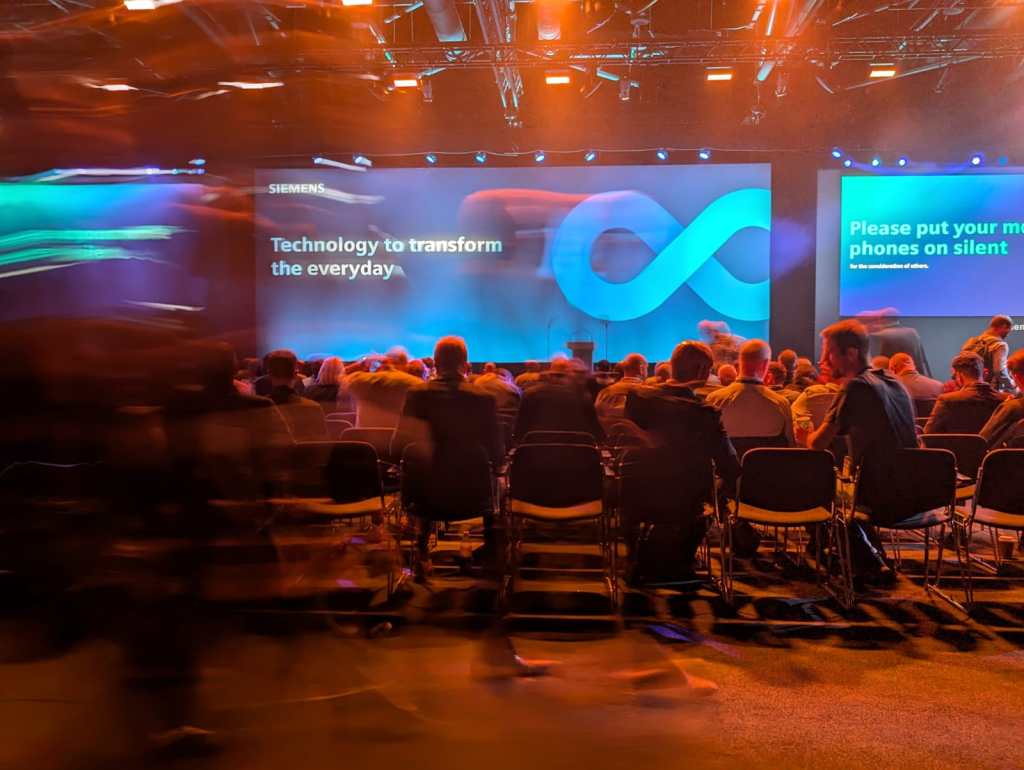
The industrial metaverse and generative artificial intelligence (AI) were the two of the biggest enablers impacting global industry, a top Siemens executive said in a keynote speech.

At Siemens Transform 2024, Carl Ennis, Chief Executive, UK&I, told audiences at the flagship event that despite popular exposure to the Meta Quest and Apple Vision Pro mixed reality (MR) headsets, the industrial and social metaverses had key differences.
He told audiences,
The social metaverse is like a place to escape from the real world and exist in the digital space. While the industrial metaverse is a digital world, in reality, it has a direct impact on the real world.
For many, the industrial metaverse was a “safe space” for people “to innovate and experiment,” offering its users the potential to “unlock the creative power” of teams, he added.
He also predicted that it had the power to “significantly outpace its commercial counterpart,” both in terms of use and impact.
Explaining further, Ennis stated,
“How far away are we from that ‘utopian’ environment? Well, the building blocks for the industrial metaverse are already here. Digital twins — the digital replica of a physical process or system — are already being used across the UK and the world.”
At many of the exhibitions across Transform 2024, Siemens and its partners had showcased numerous examples of where digital twins were “real applications [were] already being used” by customers.
For example, Siemens had deployed digital twin technologies to plan and simulate the construction of a seven-hectare factory in Nanjing, China. The digital twin had been originally designed to optimise aspects of the building site as well as optimising factory output.
He explained further,
“Now that site boasts 20 percent higher productivity than our standard factories. Volume flexibility is up 30 percent, and space efficiency has surpassed 40 percent. They’re great numbers, but what’s holding back those digital twins from evolving into the full industrial metaverse and delivering even bigger savings? There are a few things.”
According to the executive, computational power remained a concern, but NVIDIA, one of the largest companies in the world and a Siemens global partner, were “leading the way in that charge of computational power.”
Companies and organisations were urged to “break down the barriers for collaboration” to facilitate digital simulations in the industrial metaverse.
He called for the digital counterparts of physical realities, or digital twins, to operate in a system and workd together via a common language, “from light bulbs all the way to the most complex factory robots.”
Furthermore, gathering data and analysing it in real time was also a key component to the industrial metaverse, where analysts could “make meaning out of all of the potential data.”
Generative AI as a Key Component of the Technology Stack
Highlighting the need for generative AI, Ennis noted the enormous amounts of data produced at the average automated factory.
“It’s about 2,000 terabytes of data every month, or the equivalent of over half a million movies worth of streaming,” he noted.
Portfolios of factories, vehicle fleets, and entire city energy grids were also examples he cited in his speech, where data demanded GenAI solutions.
He stated that GenAI had a “symbiotic relationship” with the industrial metaverse, adding that his company’s AI needed to be “industrial grade.”
The potential impacts of AI were limited to the imagination, and industrial grade AI underpinned the “seamless creation of an industrial copilot” capable of governing from design to operations, he stated.
Citing an example from their smart infrastructure site in Berlin, Siemenssstadt Square, Ennis explained that the 76-hectare industrial area would become an urban district by 2030 and remain net-zero.
In order to achieve this, Siemens needed to merge the digital and real worlds, including reaching a 20 percent increase in productivity and 40 percent increase with the emerging technologies, as well as working to resolve modern challenges like decarbonisation, he noted.
“Every complex problems needs a chorus of intelligent minds working on it to solve it,” he stated.
Problems like product improvement and innovation, reducing research and development (R&D) time and costs, improving on future infrastructure and products with existing data, and cutting raw material wastes were all benefits of implementing the industrial metaverse and GenAI.
Ennis concluded: “If there’s only one stat that we walk out of that door with, its this next one. The most exciting thing is we can get 80 percent of the way into a decarbonised world with the technologies that exist today.”
Siemens Transform 2024 Concludes in Manchester
The Siemens Transform 2024 event took place from 17 to 18 July at Manchester’s iconic Central Convention Complex.
The massive event gathered partner firms, companies, panel experts, and many others involved in the development of next-generational immersive solutions, engineering breakthroughs, and problem-solving technologies.
The Munich, Germany-based tech giant showcased its Xcelerator programme, an ever-growing ecosystem of solutions driving global innovation, interoperability, and sustainability.
Like this article? Be sure to like, share, and subscribe for all the latest updates from DxM!



 Deus×Machina
Leave a reply to Charlamagne Tha God Joins MeetKai to Grow, Invest in Metaverse Strategy – Deus×Machina Cancel reply