
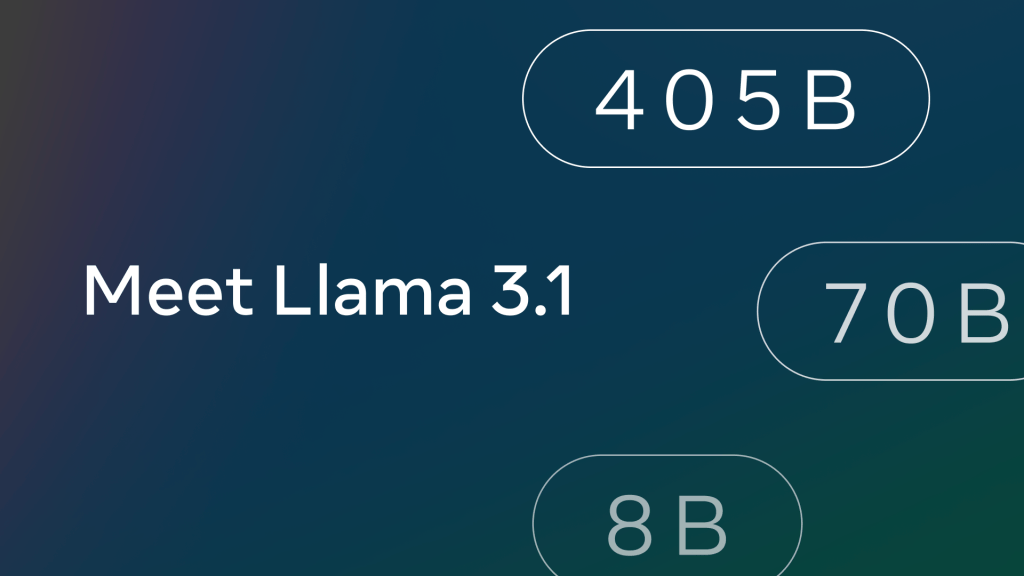
Meta announced on Tuesday that it had released its most cutting-edge version of Meta Llama available, v3.1 model 405B.
To date, users have downloaded cumulative versions of Llama over 300m times, Meta explained.
According to the Menlo Park-based firm, the latest edition rivals some of the world’s biggest AI language learning models (LLMs).
It also stated that it hopes to boost innovation across the tech sector to trigger “unprecedented opportunities for growth and exploration,” in the aim to innovate new applications, modelling paradigms, synthetic data generation, and model distillation, and more.
The new release has updated its 8B and 70B models with multilingual, 128K context lengths capable of increased reasoning capabilities.
These can apply to more complex use cases like “long-form text summarization, multilingual conversational agents, and coding assistants,” Meta said in its announcement.
Licencing has also expanded to allow developers cross-use of Llama models to improve others, facilitating open-source collaboration.
To boost the transparency of its solutions, Meta partnered with AI tech titans like Accenture, AWS, AMD, Anyscale, CloudFlare, Dell, Deloitte, Databricks, Groq, Google Cloud, NVIDIA, and many more.
Future-Proof LLM Fitness Training
Testing in the new LLM involved “extensive human evaluations” comparative to its competitors such as GPT-4, GPT-4o and Claude 3.5 Sonnet, training with momre than 15tn tokens.
To achieve this, Meta trained the LLM to “over 16 thousand H100 GPUs,” the largest Llama version of such a scale.
It also involved multiple rounds of alignment during training, involving Supervised Fine-Tuning (SFT), Rejection Sampling (RS), and Direct Preference Optimization (DPO), Meta explained.
Open Source, Community Driven
Using an open-source approach, Meta has granted Llama model access to developers to create bespoke versions, train datasets, and more, building a community powering current and future generative AI models.
Several use cases cited in the release include medical guides, AI-powered study assistants across WhatsApp and Messenger, a nonprofit solution for organising and relaying patient data from hospital visits.
Speaking further about the innovation, Mark Zuckerberg, Chief Executive and Founder, Meta, wrote in an open letter that his company was “committed to open source AI.”
He added:
“I’ll outline why I believe open source is the best development stack for you, why open sourcing Llama is good for Meta, and why open source AI is good for the world and therefore a platform that will be around for the long term.”
Developers can download the new release on llama.meta.com and Hugging Face.
Open Partnerships Expand Across Big Tech
Many of the tech giant’s AI partners have continued to collaborate to develop AI and metaverse solutions.
Recently, NVIDIA, Sony, Varjo, and Siemens formed several partnerships via the former’s Omniverse industrial metaverse solution.
With the power of the industrial metaverse, companies could collaborate remotely, design and amend prototypes in real time, incorporate AI solutions to expedite workflows, and significantly reduce time-to-market for their designs, saving time and resources.
Some of the top use cases for their collaborative efforts were revealed at the Siemens Transform 2024 event in July. Taking place at the Manchester Central Convention Centre, the German engineering giant showcased its immersive partnerships across aerospace, automotive, smart city and infrastructure, energy, and many more.



 Deus×Machina
Leave a reply to NVIDIA Posts $30bn in Revenues, Misses Q3 Estimates – Deus×Machina Cancel reply