
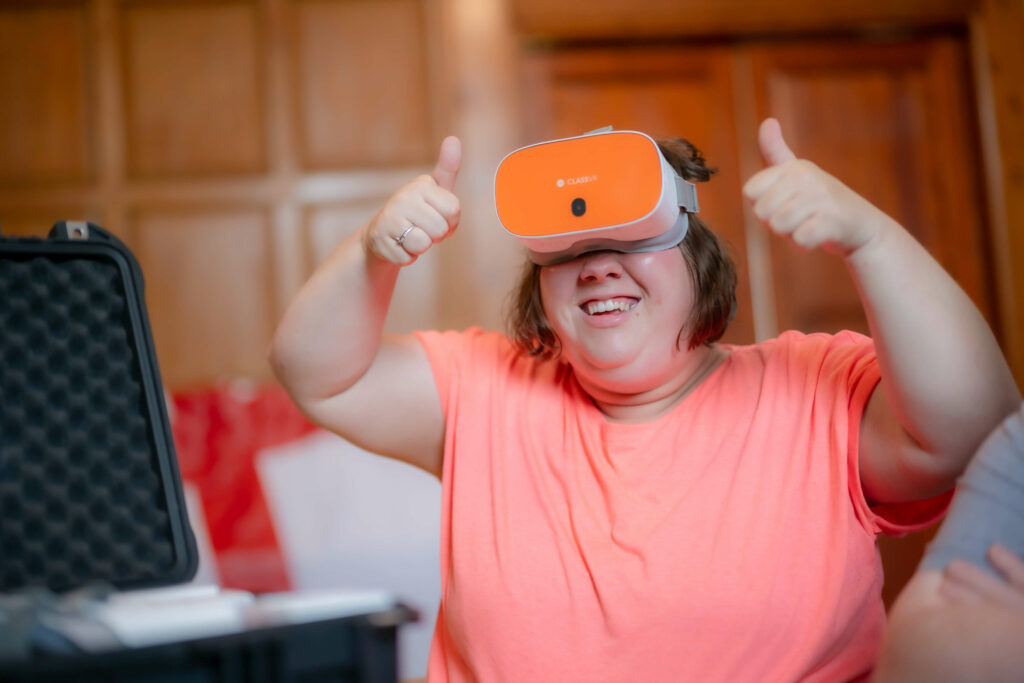
Regional charity Chrysalis has begun deploying virtual reality (VR) solutions to help people with learning disabilities with bespoke immersive experiences, the Cumberland News and Star reported on Thursday.
The Wigton-based organisation has been backing 70 people across the region of North Cumbria.
Recently, Fibrus Broadband provided the charity with a major grant to procure VR devices and learning and development (L&D) software, the report said.
Crysalis earned the maximum grant amount for its pilot — £2,000 — from Fibrus Broadband’s fund. The latter company provided their total monetary support of £50,000 to around 30 projects across the Cumbria region.
Therapeutic VR for Those in Need
Some of the VR experiences include virtual country, art gallery, theatre, sailing, shopping, concert, and other visits, it noted.
Claire Doherty, Chief Executive, Chrysalis, said in a statement that the grant to buy VR headsets would “enhance our usual activities and visits and help people to prepare for them, and to practice life skills.”
She continued that some of the users found new physical environments difficult, but that VR could incrementally help users adjust to each one, building their confidence.
To her, virtual reality allowed her clients to experience “opportunities to do things they might never get the chance for in terms of travel.”
She added: “You could visit the Globe Theatre in London or be walking through a jungle or visiting a music festival, or a country in South America or Asia.”
Furthermore, some of her clients faced sensory overload issues when visiting new places, and VR allowed them to acclimate accordingly, namely with immersive experiences like music and relaxing scenes.
Fibrus Fund: Tackling Digital Poverty
Fibrus Broadband explained that the fund serves as a countermeasure to digital poverty, backing major organisations such as Longtown Community Hall and Friends of Newton School.
The former created an iPad loan programme with the funding, and the latter bought 11 laptops.
Linda McMillan, Chief People Officer, Fibrus, explained that one of her company’s main goals was to “enhance people’s lives by improving digital literacy and connectivity.”
She added: “We believe every person deserves access to essential services in Cumbria and beyond and The Fibrus Community Fund is a vital part of our mission to foster a more digitally inclusive society.”
Lisa Blackwell, Grants and Programmes Officer, Community Foundation Cumbria, commented that reducing digital poverty was “crucial to tackling the ‘digital divide’,” increasing opportunities and “health and wellbeing outcomes for whole communities.”
Chrysalis works in partnership with a network of organisations, including JobCentre Plus, the University of Cumbria, People First, Cumbria Partnership NHS Trust, Esk Consulting, and many more.
VR Rehabilitation and Learning Disabilities Study
The news comes after a study last year showed that VR provided significant improvements in learner retention, cognitive functioning, and other metrics for children with specific learning disorders (SLDs).
Using immersive learning tools, the study incorporated 24 children with SLDs, aged 7-11, to train on the spatial computing devices for six weeks at the IRCCS Don Gnocchi Foundation—Santa Maria Nascente’s CARE Lab.
Based in Milan, Italy, the institution developed the study to provide a “rehabilitative setting with recreational and semi-immersive features.”
Using a time-point system to evaluate subjects — before VR interventions, immediately after, and after six months’ time — researchers tailored the programme to each patient with “different games with variable complexity levels,” the study read.
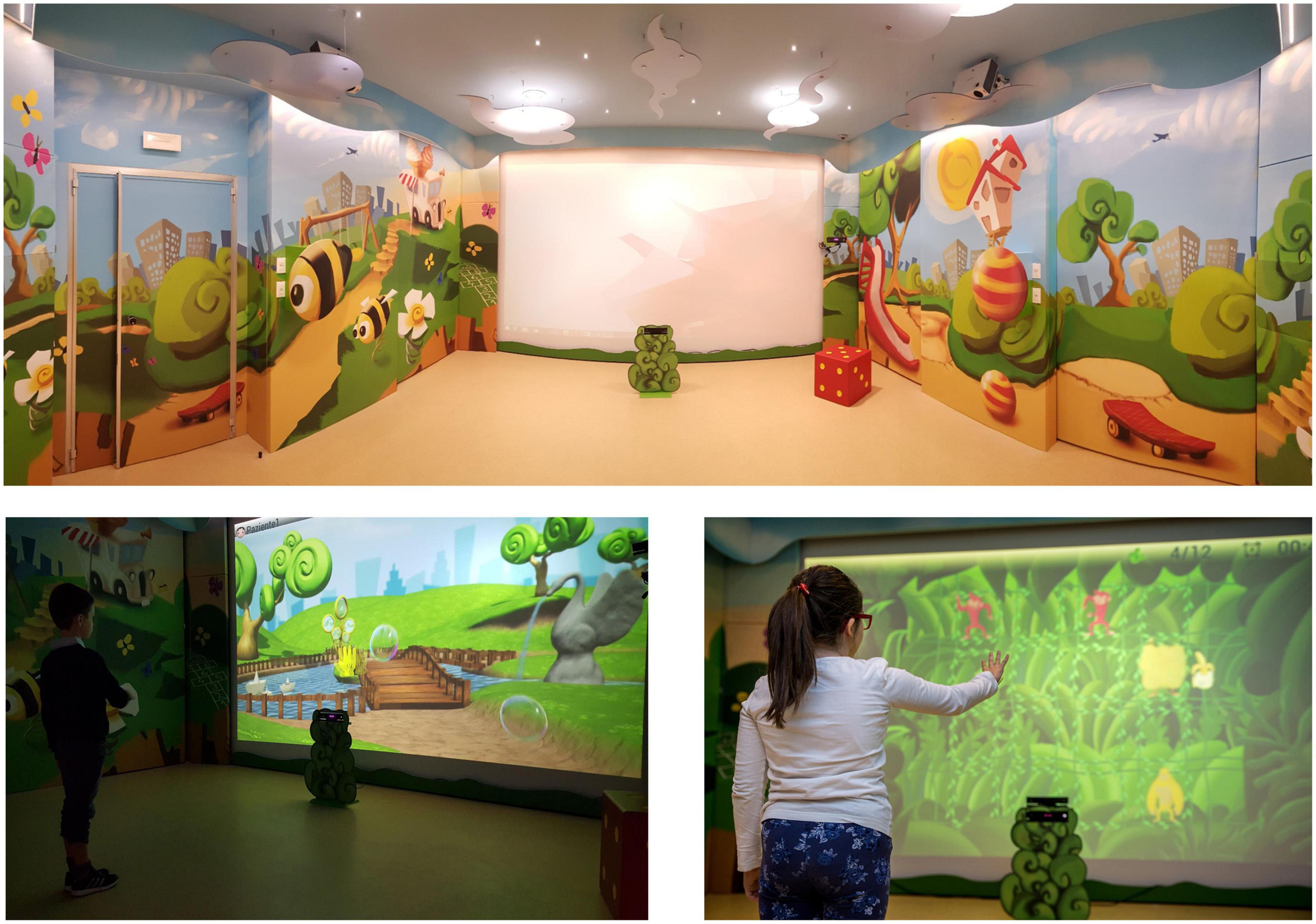
According to the results, metric scores for visual attention, inhibition, flexibility, and planning were “significantly higher than before the intervention,” adding they were mostly “maintained after 6 months.”
The report abstract concluded that the study would “provide important inputs” for developing innovative rehabilitative interventions for children with SLD, based in “ecological and evidence-based approaches.”
Like this article? Be sure to like, share, and subscribe for all the latest updates from DxM!



 Deus×Machina
Leave a reply to VR Effective in Teaching Life Skills to People with Intellectual Difficulties — Study – Deus×Machina Cancel reply