
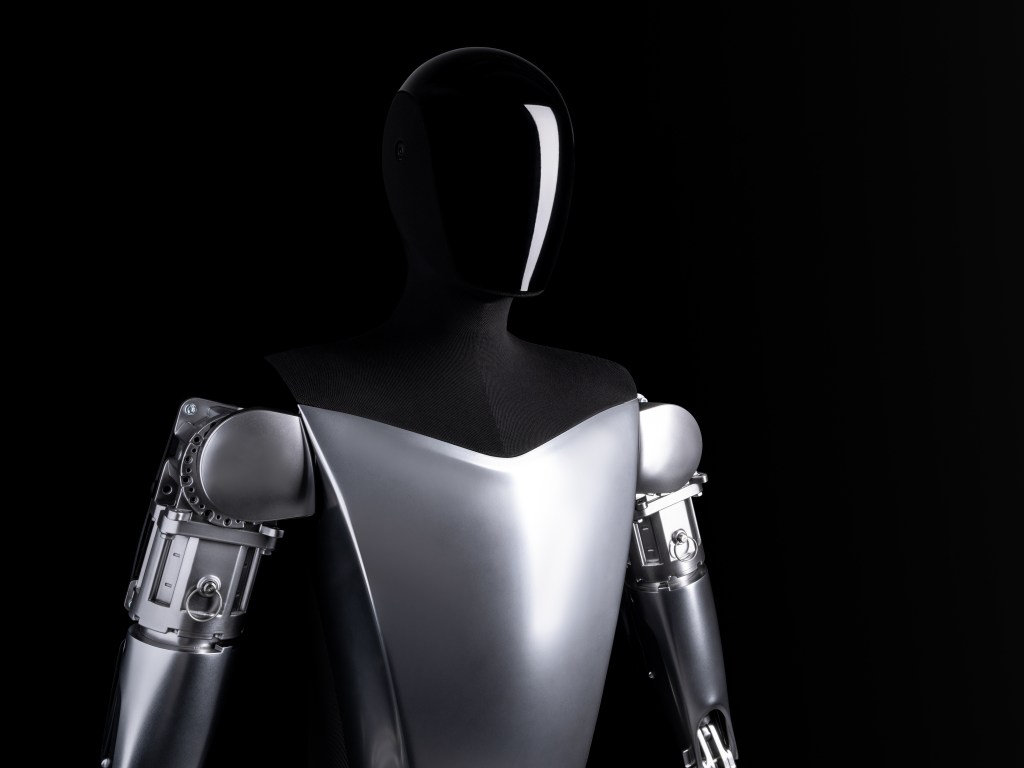
Tesla Inc has posted a job opening for people to wear virtual reality (VR) headsets to train the company’s Optimus robots.
With the immersive tools, new hires can help the Palo Alto-based tech firm gather data, receive engineering requests, and offer feedback on equipment, the company’s job posting wrote.
For the potential candidate, Tesla requires them to “be able to make data driven decisions” and have an “enthusiasm for the field of robotics.”
New hires will need to wear a motion capture (mocap) suit and VR head-mounted display while walking, performing actions, and “minor equpiment and software debugging” functions along assigned test routes daily to collect data for Tesla’s robotics programme.
Additionally, candidates must also offer feedback on equipment performance, analyse and report collected data during their shifts, and write daily reports on their observations and issues with testing kit.
The only caveat is that they must walk seven or more hours a day with up to 30 pounds of weight. Hires can also only measure from 5’7″ to 5’11’ due to the robot’s height and mocap suit limitations.
It also cautioned that working with VR headsets could cause “disorienting and uncomfortable” knock on effects due to “VR sickness symptoms.”
Due to the full range of motions sought for Tesla’s mocap programme, daily activities could prove demanding for some people.
Accenture Invests in Robotics Firm Sanctuary AI
The news comes after Accenture announced in March that it had strategically invested in humanoid robot developers Sanctuary AI to build AI-powered models capable of general work tasks.
Through the AI firm’s Carbon control system, its ANI-capable Phoenix robot model “mimics subsystems found in the human brain, such as memory, sight, sound and touch, and translates natural language into action in the real world,” the announcement read.
Speaking on the investment, Joe Lui, Global Advanced Automation and Robotics Lead, Accenture, explained that the robots would become “essential to reinventing work and supporting human workers.”
He noted that “labor shortage is becoming an issue in many countries and industries.”
He continued,
“Sanctuary AI’s advanced AI platform trains robots to react to their environment and perform new tasks with precision in a very short time. We see huge potential for their robots in post and parcel, manufacturing, retail and logistics warehousing operations, where they could complement and collaborate with human workers and automate tasks that traditional robotics can’t.”
Geordie Rose, Chief Executive and Co-founder, Sanctuary AI, noted that robots with human-like intelligence would “completely transform the workforce of the future.”
This statement comes after Accenture published its Technology Vision 2024 report, which called on global industries to embrace more human-like technologies to empower their respective sectors.
The report stated,
“Where AI once focused on automation and routine tasks, it’s now shifting to augmentation, changing how people approach work, and is rapidly democratising the technologies and specialised knowledge work that were once reserved for the highly trained or deep pocketed.”
It also found that 95 percent of respondents said that more ‘human by design’ technologies would “massively expand the opportunities of every industry.”
What’s the Future of Labour?
While enticing candidates with an hourly salary of $25.25 to $48 USD and other perks, the programme will eventually use the Optimus for a host of use cases, from working in factories, environments requiring repetitive manual labour, and even exploring environments based on their terrain.
Incorporating mocap, telemetry, and geometry data into a robot’s mobility training offers the most lifelike conversion of human-to-robot motion.
Tesla is exploiting this to deliver qualitative and quantitative progress on the bot’s machine learning (ML) journey before its Gen III release.
However, in Murray Shanahan’s book, “The Technological Singularity,” he discusses robotics as “the technology of embodiment” where artificial narrow and general intelligence (ANI, AGI) neural networks can take suitable humanoid forms to complete its domain (type of sector) functions.
He writes about embodying a mouse brain mapping AI with a suitable medium (robot), stating,
“The final stage of the emulation process is to interface the simulated brain to a synthetic (robot) body […] The robot body could in principle take a number of forms, more or less like the body of a mouse. But the interfacing problems are fewer if the body is as mouse-like as possible.”
The need for a close replica of the original body suitable for specific tasks also coincides with Tesla’s Optimus programme: it seeks to record, gather, and convert geometric mocap data to improve a human-form robot. This type of job can map out motions in the human body like joint, gait, posture, fluidity, and other parametres needed to increase the Tesla Bot’s metrics.
This is process known as biomimicry, where robots emulate the movement, materials, or capabilities of biological species such as humans, fish, birds, dragonflies, and many others to execute specific functions.
This seemingly simple operation has humbled researchers seeking to emulate theirs and other species due to several challenges.
Despite their simple challenges, Shanahan notes that robotics requires researchers to achieve massive computational and physiological milestones, increasing the demand for several technologies such as:
- Sufficient or exemplary compute power (semiconductors) capable of ANI/ AGI neural networks-to-physiological robotics
- Subjects closely matching AI neural networks to physical embodiments (human neural network -> human body) to facilitate emulation
- Rehabilative training to align and upgrade AI-robot capabilities within the limits of current compute and technologies
- Power requirements matching sought capabilities (runtime, force, etc)
Companies like Boston Dynamics, Hansen Robotics, Engineered Arts, OpenAI, Unitree, Agility Robotics, and Apptronik have chosen these human forms with their updated Atlas, Sophia, Ameca, Figure 01, G1, Digit, and Apollo robot models, respectively.
This is the one of the most challenging AI-to-robot neural network conversions to date, but which can provide some of the greatest data and physiological feedback loops for robotics engineers.
Current technological capabilities limit robots to automated warehouse work, robot-human interactions, conversational AI, exploring dangerous environments, and military missions, among others. As substrates improve, so will the robot’s capacity to interact with humans (and each other with ML) and carry out tasks, functions, and otherwise.
Tesla’s latest job search, while it could replace some human jobs, it will also bring humanity one step closer to working with humans in the real world. The competition has already begun amongst AGI firms like Tesla’s xAI, OpenAI’s ChatGPT, Unitree, and other rival companies.
Like this article? Be sure to like, share, and subscribe for all the latest updates from D×M!


 Deus×Machina
Leave a reply to What to Expect from the Council of Europe’s AI Convention – Deus×Machina Cancel reply