
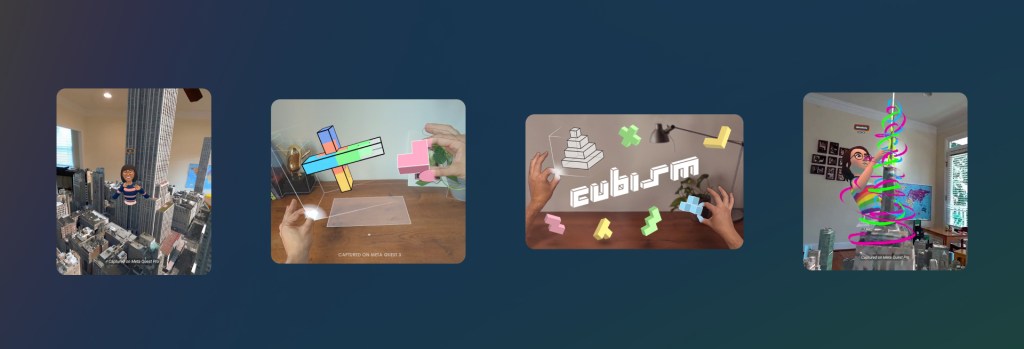
Meta Platforms has revealed several mixed reality (MR) “motifs” linked to its Quest headset passthrough technologies, technical features, and application programme interfaces (APIs).
In a Thursday blog post, the Menlo Park-based enterprise explored how developers transitioned from fully immersive to MR experiences via Passthrough, and how this functionality benefitted those building their own apps on the Meta Quest store.
With passthrough, MR headsets can deliver merged experiences between the physical and digital world using hi-res device cameras.
However, two scenarios — contextual passthrough and conditional passthrough — created respective challenges for developers.
Meta explained that, in contextual passthrough, the function works based on system recommendations, toggling between the system splash screen (initial boot screen) and Unity scenes with interactive digital content.
Meta OS users can enable this feature in the Unity OVR Manager’s System Splash Screen Background feature to toggle this on and off.
Games like Cubism leverage this technique to load with contextual Passthrough, and then later continue gameplay with uninterrupted Passthrough visuals shortly after.
However, with conditional passthrough, users can toggle between MR and virtual reality (VR) “on-command,” leading to partial or full physical or virtual environment integrations during use.
Meta recommends switching between modes to avoid black flickering errors in visualisation. Fade screens can also leverage main camera quads that can facilitate transitions.
The Meta Core software developer kit (SDK) on Unity allows developers to “selectively reveal Passthrough.” Other use cases included removing boundary spaces for more immersive app experiences via Meta’s Boundary API, the report added
For more information, users can view Meta’s passthrough documentation at their website.
Zuckerberg Outlines Smart Glass ‘Vision’ at SIGGRAPH 2024
News of the Dev update comes just days after a report from The Information via UploadVR found that the tech giant aimed to produce a lighter Meta Quest headset.
Codenamed Puffin, the device would release in 2027, incorporate a large smart glasses form factor nearly one-fifth the weight of the Meta Quest 3, and would use a power and compute puck similarly to the Vision Pro to offload weight, heat, and compute demand from the headset.
The announcement followed updates that it would no longer develop its Meta Quest Pro 2, a rival device to the Apple Vision Pro, due to expensive displays and low demand for the competitor headset. It also discontinued development and availability of its Spark AR platform for third-party developers, just a month ahead of its Meta Connect address in September.
Doing so may allow Meta to retain its status as the world’s largest supplier of consumer and enteprise headsets, in addition to adhering to its Year of Efficiency commitments as stated by Mark Zuckerberg, Founder and CEO, Meta, at a recent event. D×M understands that discontinuing the Spark AR platform ahead of Connect 2024 could hint at an upgraded solution.
Meta has also consistently stated that it aimed to move towards lightweight form factors as it predicts smart glasses to become the main kit adopted globally for consumers and enterprises in the future.
It has attempted to incrementally reach this goal by partnering with Ray-Ban and Essilor Luxottica, leading to Meta’s Ray-Ban Stories smart glasses.
Speaking at the SIGGRAPH 2024 with Jensen Huang, Chief Executive, NVIDIA, Zuckerberg stated in late July that the next computing platforms would break down into “mixed reality, the headsets, and then smart glasses.”
He said at the time,
My view is that (MR headsets and smart glasses) are going to be both in the world. I think the smart glasses are going to be sort of the mobile phone, the kind of ‘always on’ version of the next computing platform, and the mixed reality headsets are going to be more like your workstation or your game console, where, when you’re sitting down for a more immersive session and you want access to more compute.
Like this article? Be sure to like, share, and subscribe for all the latest updates from D×M!




 Deus×Machina
Leave a reply to Meta Unveils Horizon Worlds v178 Updates – Deus×Machina Cancel reply